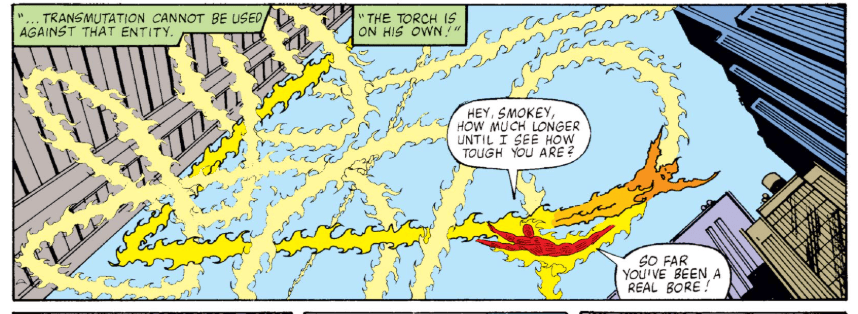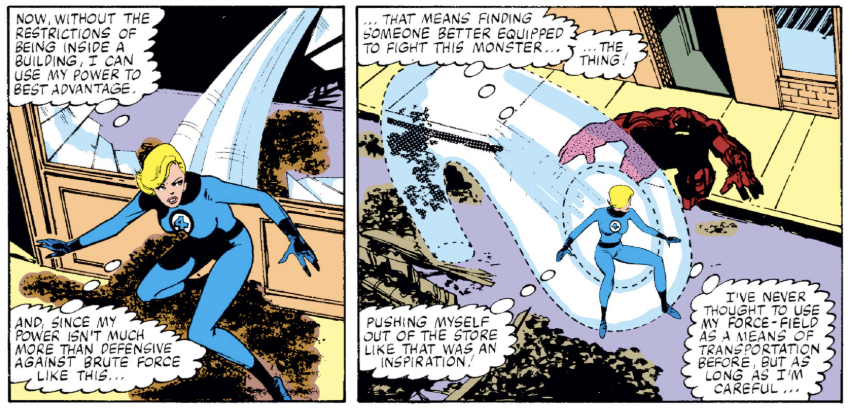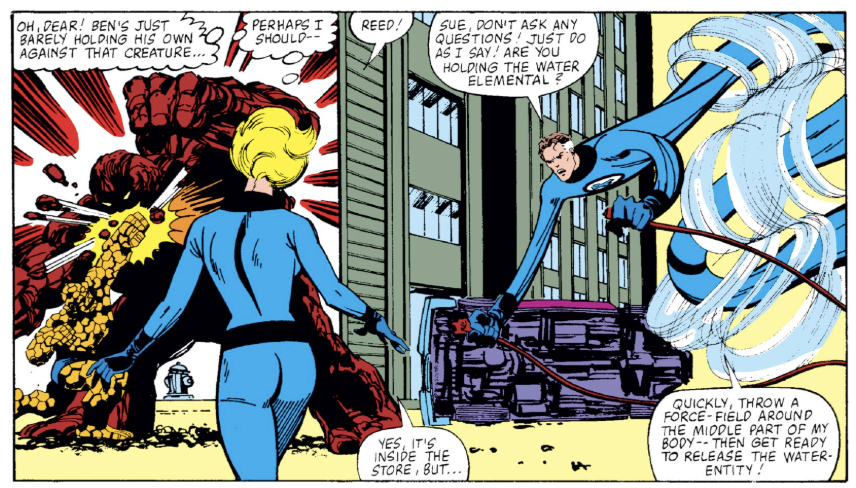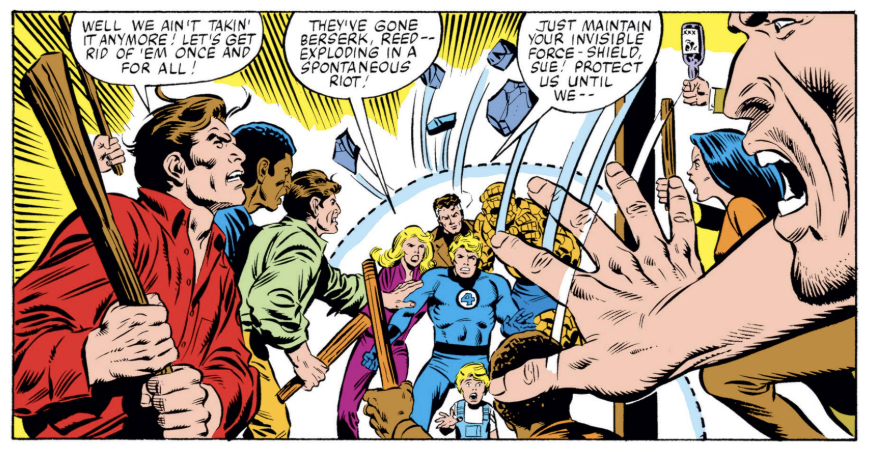
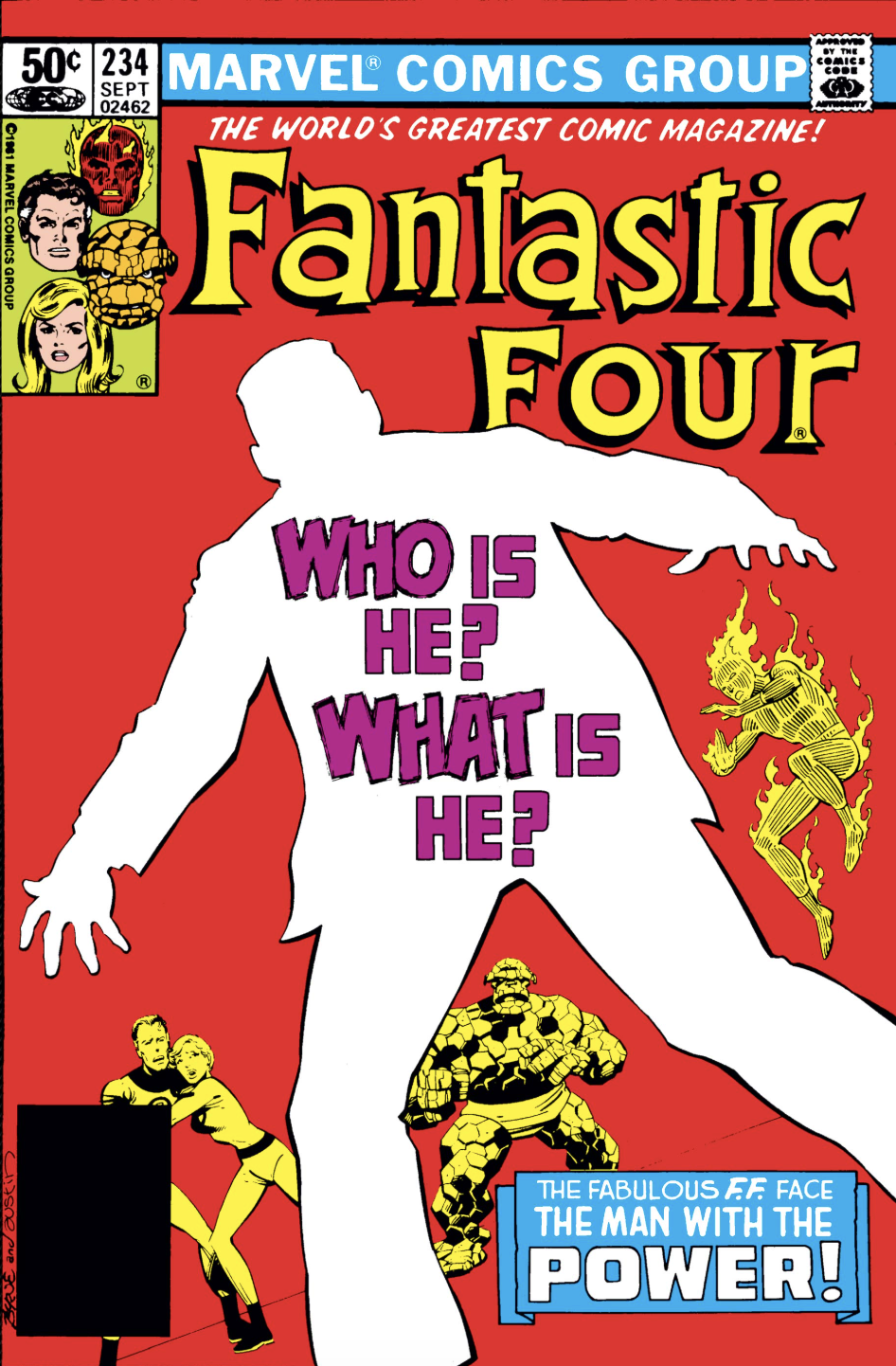
“The World’s Greatest Comic Magazine!” Fantastic Four No. 234

Tags

, , , , ,

Fantastic Four 234
“The Man With The Power!”
Published June 1981
Writer: John Byrne
Pencils: Byrne
Inks: Byrne
Letters: Jean Simek
Colors: Bob Sharen
Editor: Jim Salicrup
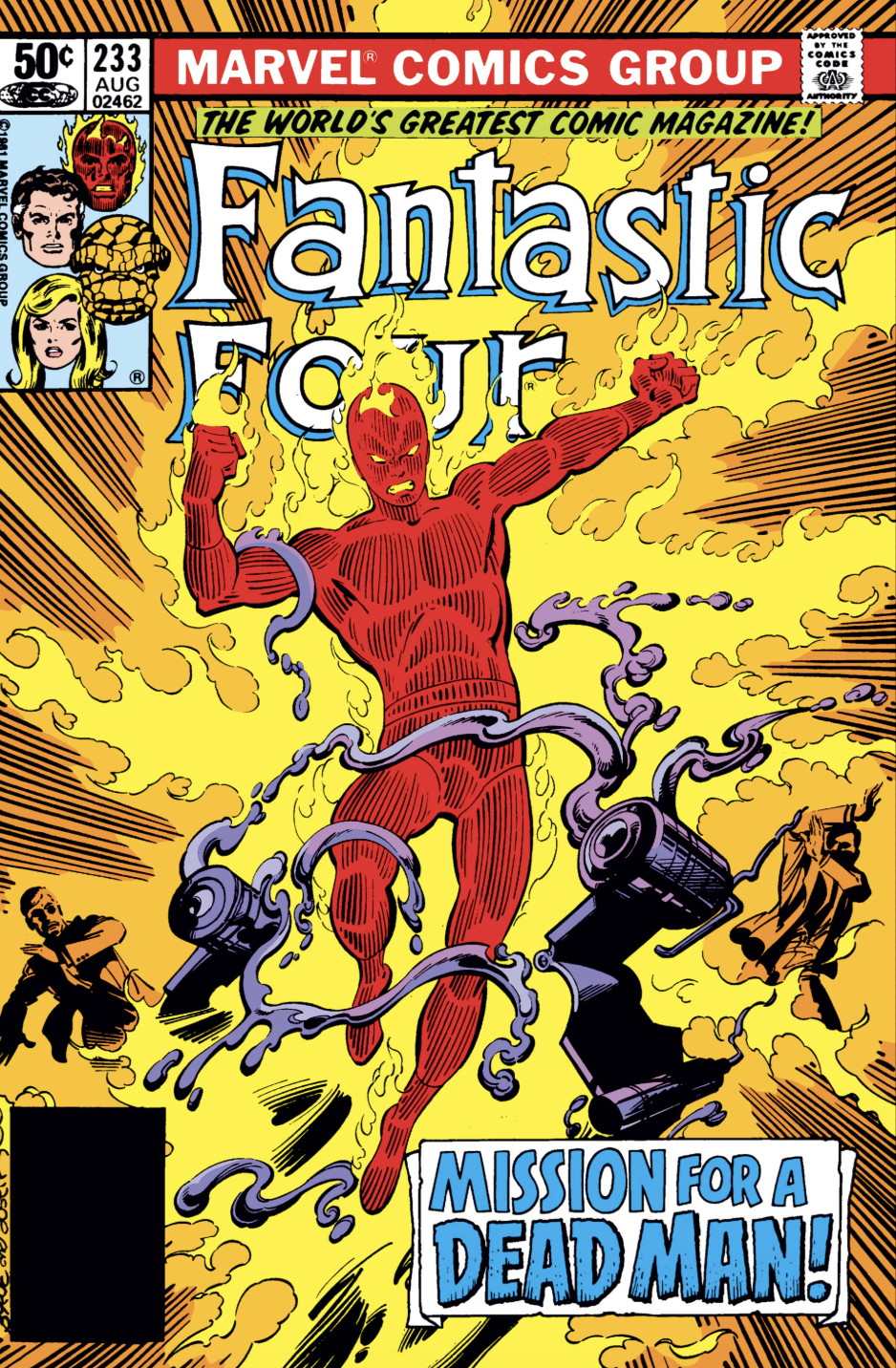
Cover: Byrne and Terry Austin


Some news: I’ve created a Substack and have started re-posting earlier entries from this site there. My long-term plan is to eventually transition this blog from WordPress to Substack, but not for a while. I will give you plenty of head’s up before that happens. In the meantime, check out the Substack (https://fantasticfourfan.substack.com/) and please subscribe. Thank you!

Synopsis

The comic begins by following Skip Collins, an average man who unknowingly has extraordinary powers to remake reality. On a business trip to New York, Collins observes members of the Fantastic Four help save lives as gravity waves from space pummel the city. Collins eventually uses his powers to return Earth to normal as the FF travel to space to discover the source of the chaos is Ego, the Living Planet.

What’s going on here?

This is an interesting issue, and one that shows Byrne’s ambitions as a writer, although I’m not sure it’s ultimately successful. Like last issue, it begins with an in-depth focus on an individual unconnected to the FF, but who somehow crosses their paths. As in the last issue, Byrne really emphasizes the celebrity of the Fantastic Four, and contrasts their star power with the ordinary people who view them from afar (and I wonder of Byrne is taking this approach after years of dealing with the outcast X-Men). In this case, the FF never meet Skip Collins, and only the Thing has any sort of encounter with him.

And therein lies the story’s problem: Despite the elaborate build up, Collins is never really the focus of the story’s action, and while we are primed to believe he is the source of the devastating gravity waves, it’s a red herring, since they come from Ego. In fact, it feels like the whole purpose of introducing Collins is for him to clean up the mess the FF leave behind as they fly into space. Byrne essentially introduces a character with Beyonder-like power, then dismisses him before he can ever interact with the comic’s protagonists. By the end of the story, Byrne tells us Collins has lost his powers, and he never appears again.

Terry Austin returns to ink the cover, although his talents seem wasted with this one, and Jean Simek makes her debut as an FF letterer, despite having spent a decade lettering a wide range of titles at both Marvel and DC.

What I liked

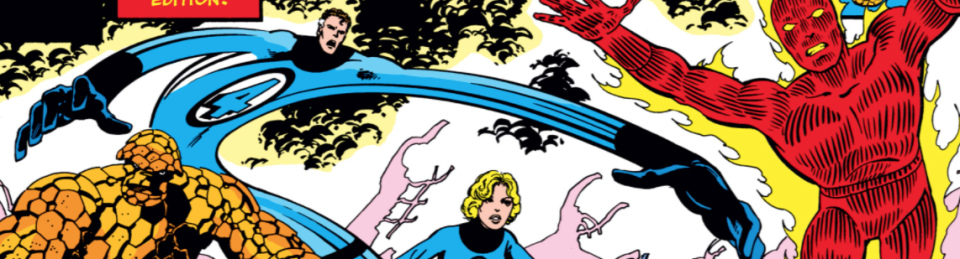
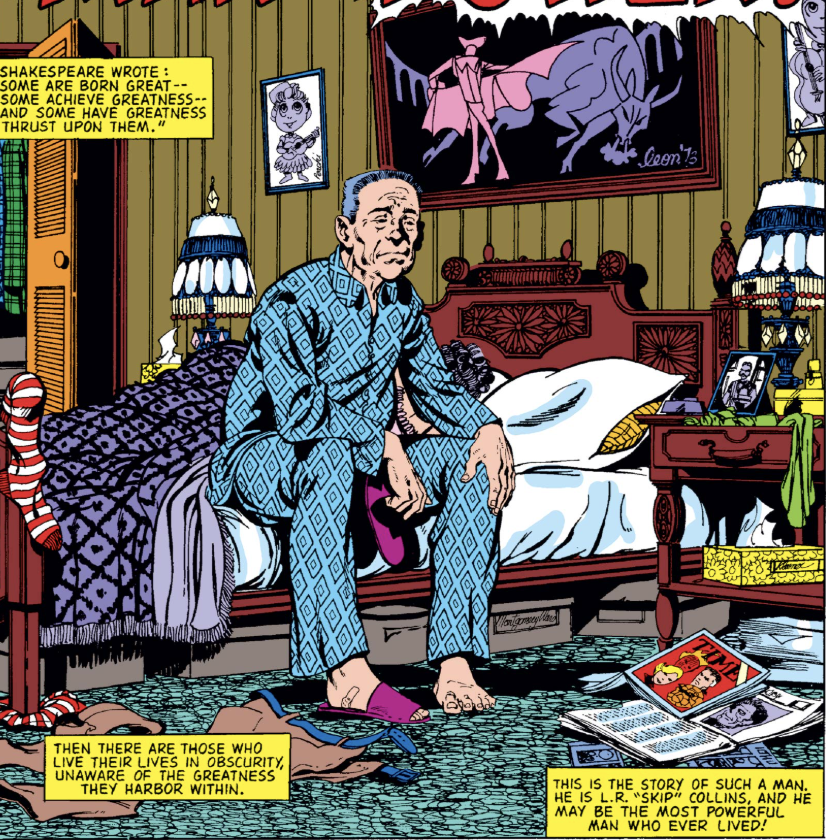
The star of the show is again Byrne’s art, which is just off the charts. Check out the detail in the image above (from the title splash page). The FF on the TIME cover, Collins’s band aid, the odd paintings, the carvings on the headboard, the patterns on his pajamas and bedspread. It’s a virtuoso performance, and there another dozen like it in the comic. His best images may be when he shows the before-and-after when Collins uses his powers, like here:
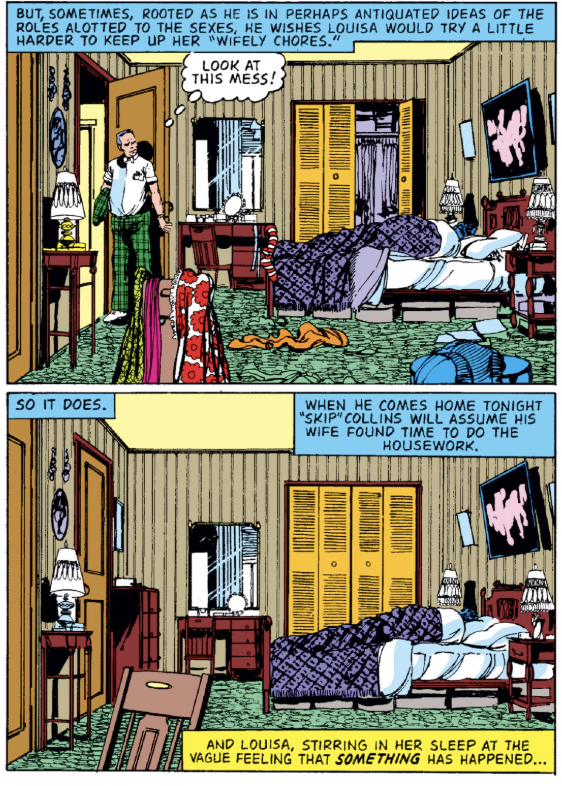
and here:
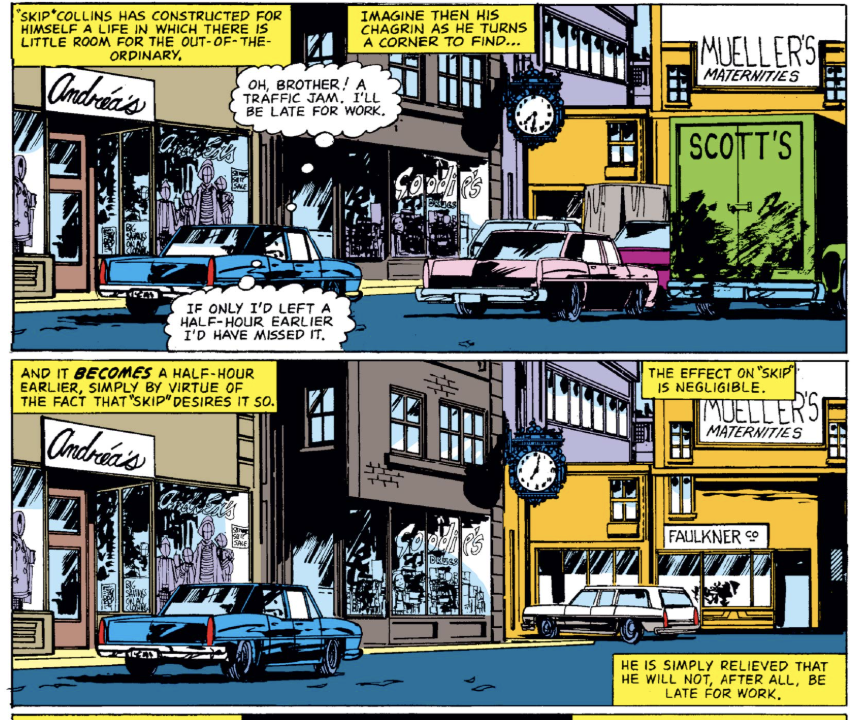
(I’m curious about the names above the stores (Andrea, Coodie, Mueller, Faulkner. They’re not other comic creators, at least none that I recognize — I’m guessing friends of Byrne.)

This sequence was also impressive:
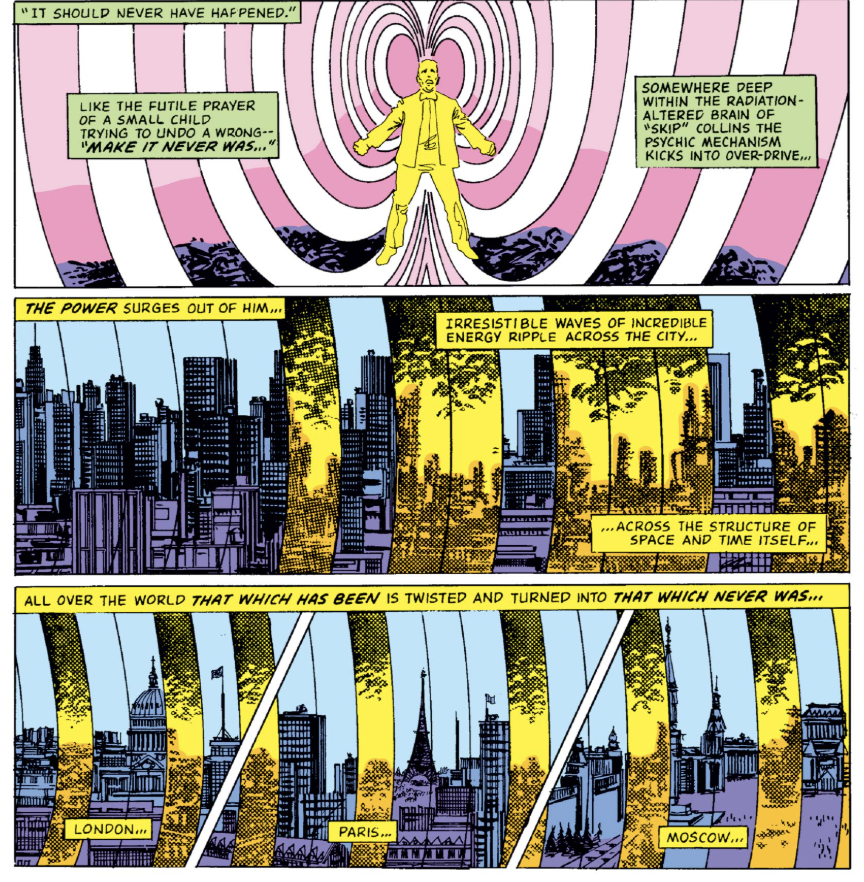

Byrne’s politics are always a bit of a mystery to me, and hopefully they will become clearer as I re-read his run. Sometimes I think he’s a traditional conservative, sometimes a libertarian, sometimes a liberal. This sequence seems to be saying something, I’m just not sure what:
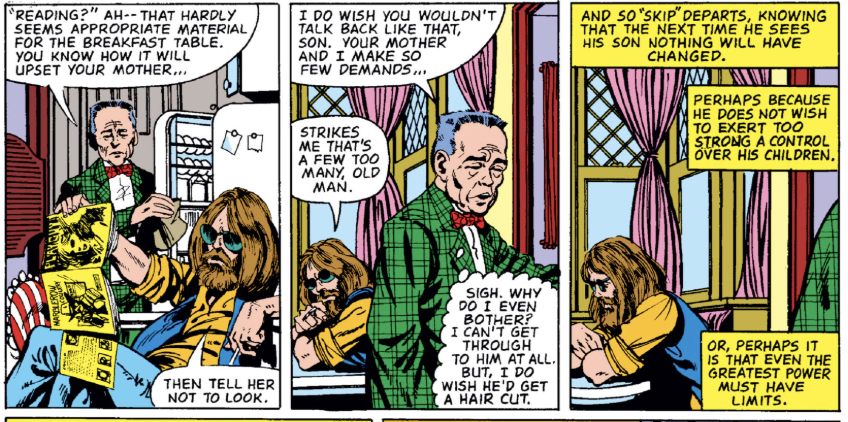

I liked this sequence with Ben and his friend, Mick Clancy, a bar keeper and former test pilot. Unfortunately, this is first and last appearance.

What I didn’t like

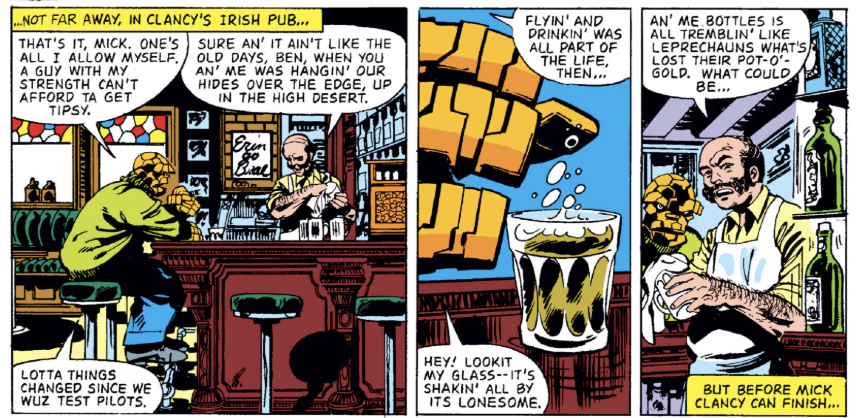
I’ve already explained why I think the story doesn’t really work, and Collins’s elaborate backstory, which includes a flashback to his time in the army when he got his powers from a atomic bomb test, seems unnecessary for a character that never shows up again.

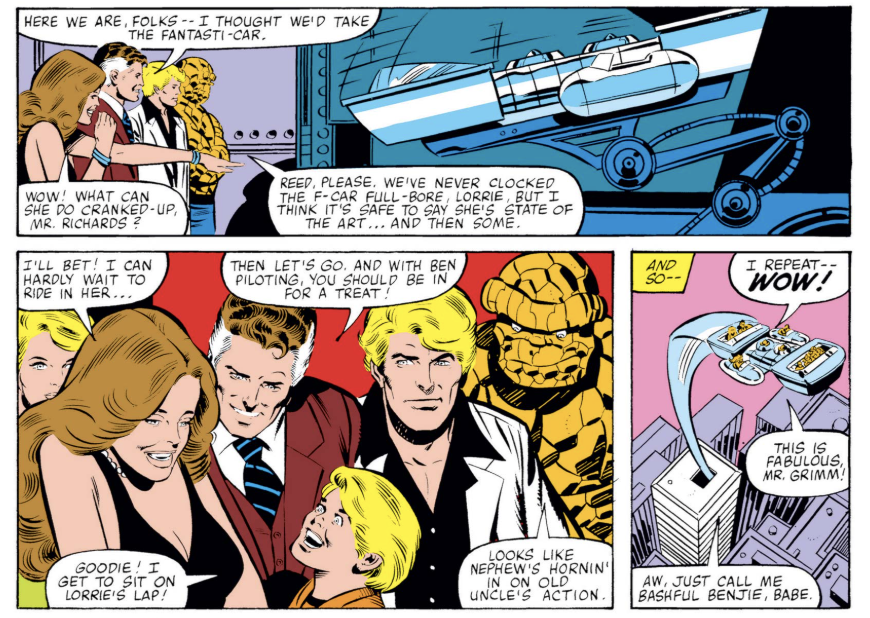
Byrne also continues explaining that which need not be explained, like here:
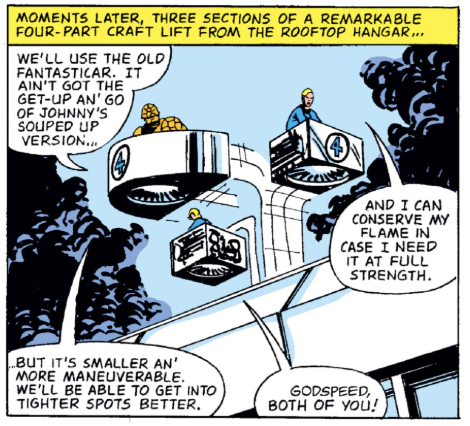

We really don’t need to know what they chose this particular Fanasticar. We trust them. Really.

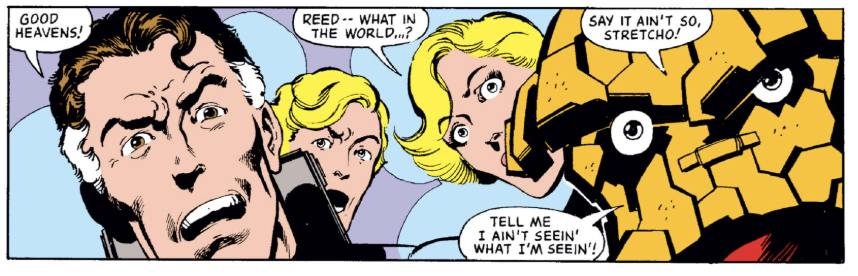
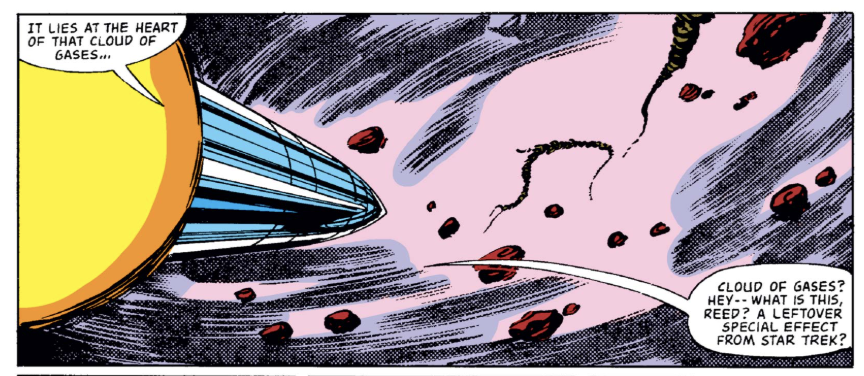
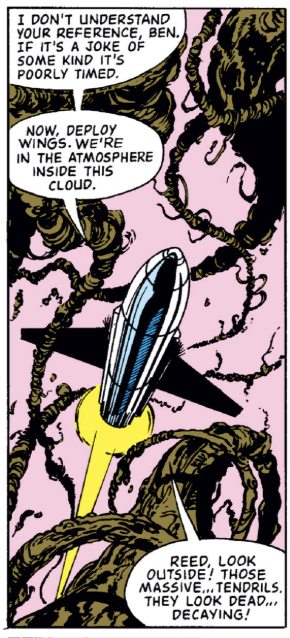
Also, this sequence seems a bit unfair to Reed. Reed is an egg head, but we’ve seen that he’s plugged into the world. It seems that a guy who invented a spaceship and met dozens of aliens would have at least heard of Star Trek.

Anything else?

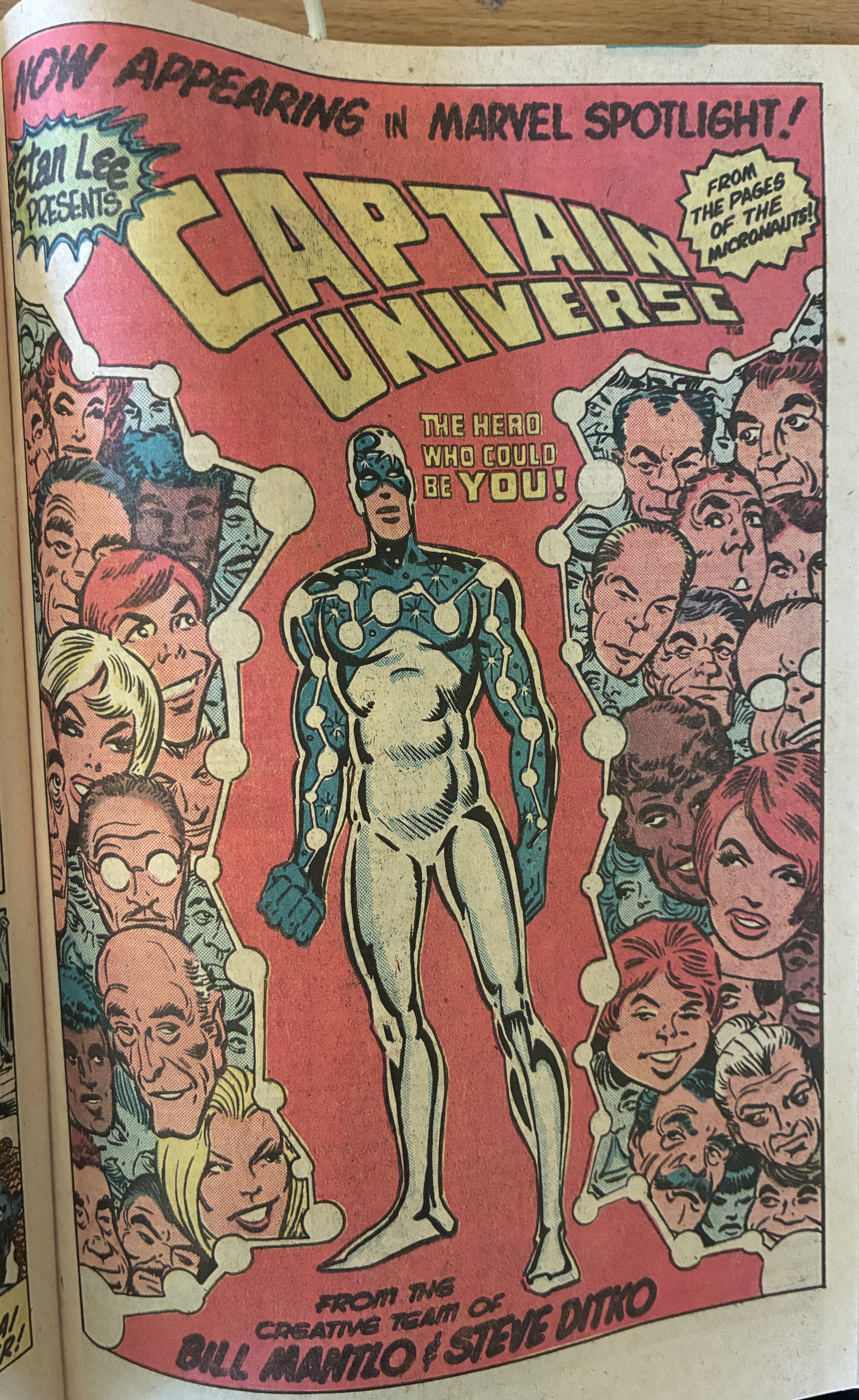
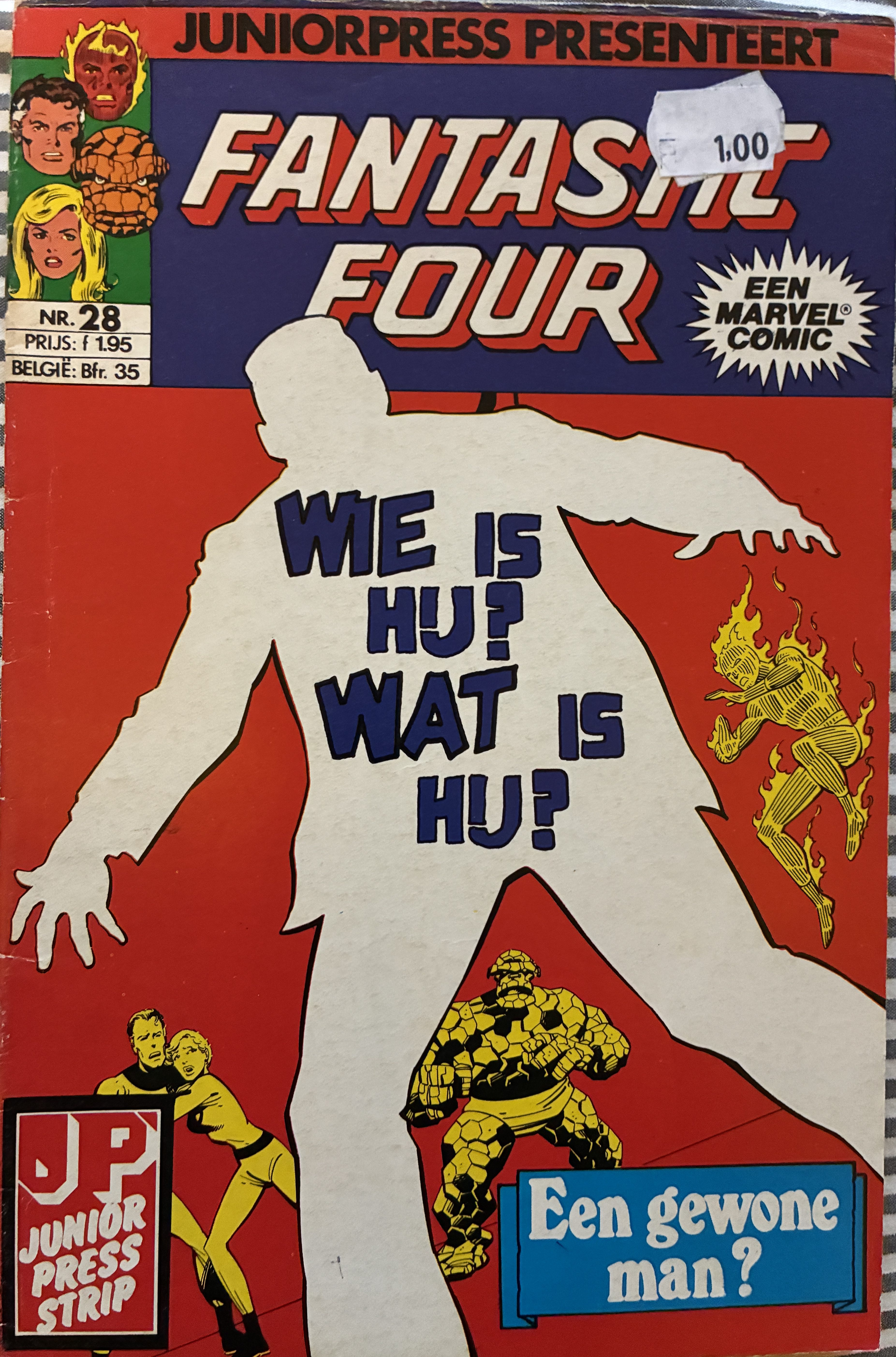
A friend recently was on vacation in the Netherlands and brought me back this comic as a present. Thanks Jeff!

Overall

Not his best, but still solid effort from Byrne.
“The World’s Greatest Comic Magazine!” Fantastic Four No. 233

Tags

, , , , , ,

Fantastic Four 233
“Mission for a Dead Man!”
Published May 1981
Writer: John Byrne
Pencils: Byrne
Inks: Byrne
Letters: Jim Novak
Colors: Glynis Wein
Editor: Jim Salicrup
Cover: Byrne and Terry Austin

Synopsis

Condemned prisoner Georgie Munson asks a priest to deliver a message to the Human Torch, asking him to exonerate him for the murder for which he’ll be executed. After receiving the letter at the Baxter Building, Johnny, who knew Munson in high school, begins investigating, and eventually follows the trail to “maggia” strongman Hammerhead. The two fight, and while Hammerhead escapes, the police arrest his associates. Johnny eventually uses the Kingpin’s records to reveal Munson was framed for murder while committing a robbery.


What’s going on here?

This is an odd comic, particularly for John Byrne’s second issue in the driver’s seat. It’s a solo story, featuring the least compelling member of the Fantastic Four. It’s a detective story, starring a character who never solves crimes. And it’s basically anticlimactic, since Johnny has to rely on the Kingpin’s records turned up by Daredevil to piece together the mystery. Overall, it reads like an old issue of Strange Tales starring Johnny, rather than the Lee / Kirby FF stories Byrne loved so much. I wish I knew why Byrne chose this story right out of the gate; my guess is he had it in his back pocket — maybe as the plot for a Marvel Team-Up story — and chose to use it here instead.

Byrne’s art is, of course, excellent (get used to me saying that), and the story has its moments, but it takes a while to get going and there is again way too much exposition.


What I liked

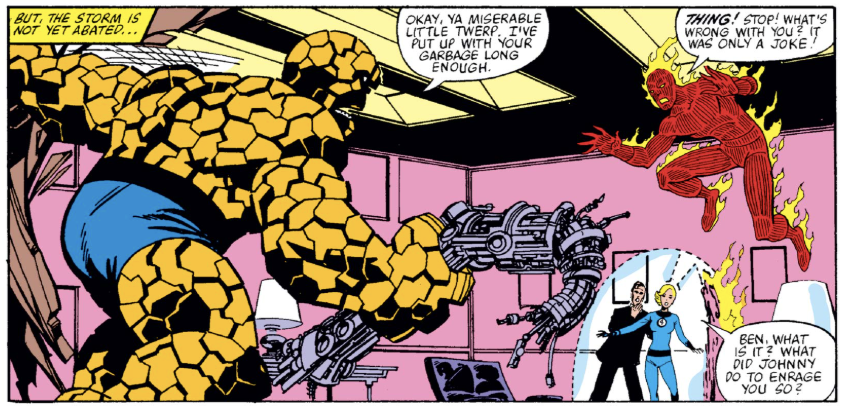
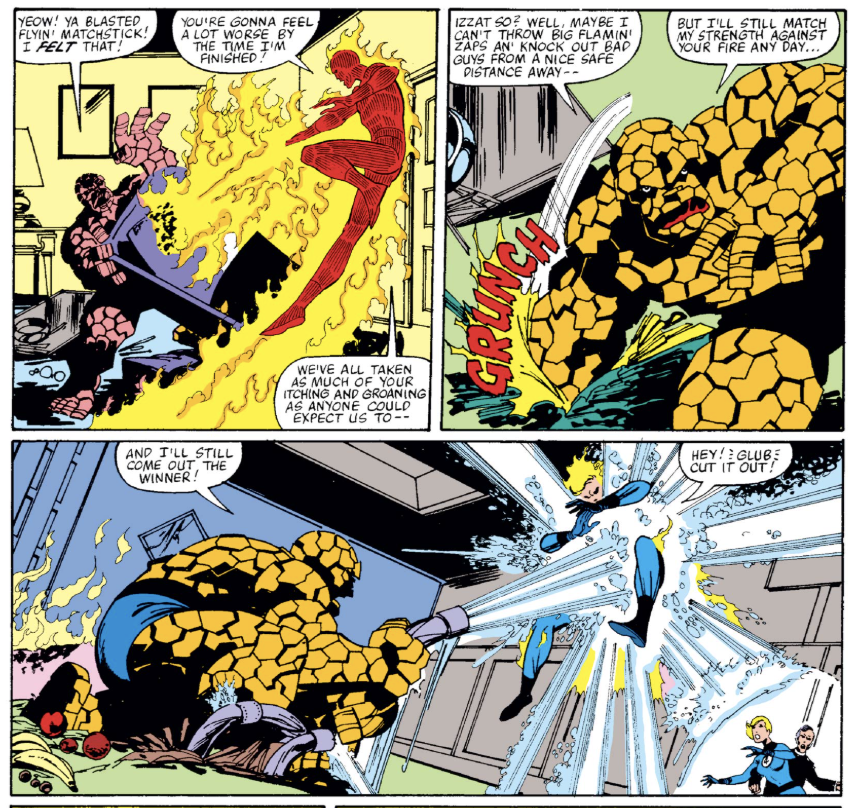
As befits his “back to basics” approach, Byrne introduces the Fantastic Four with the Thing and Torch fighting in the Baxter Building, as Jack and Stan did about two dozen times. This fight seems particularly vicious, though, and Byrne does a great job of sequencing the action throughout the panels.


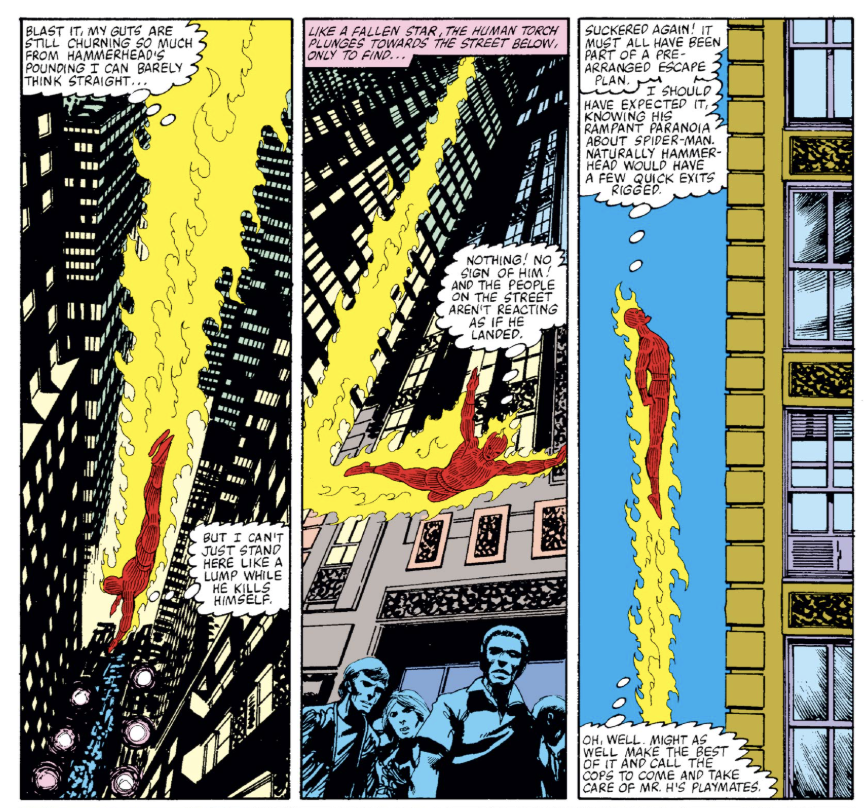
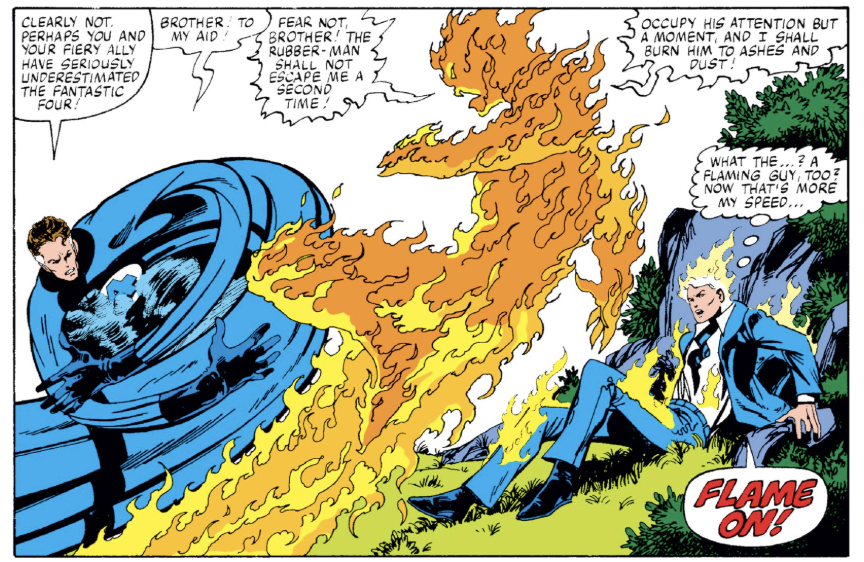
He does something similar here, where you can feel the action move you from panel to panel:


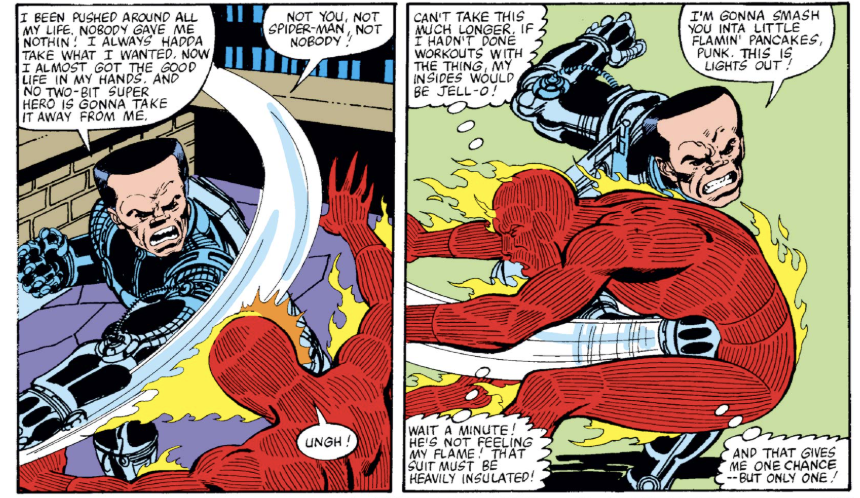
And here, you can tell that after Hammerhead swings with his right, he’s going to follow with his left:


I also liked this panel of Sue dressing down Johnny. After being called out for his immaturity, it raises the stakes as he takes on the responsibility of fulfilling a dead man’s request. Sue’s haircut is great, too.


What I didn’t like


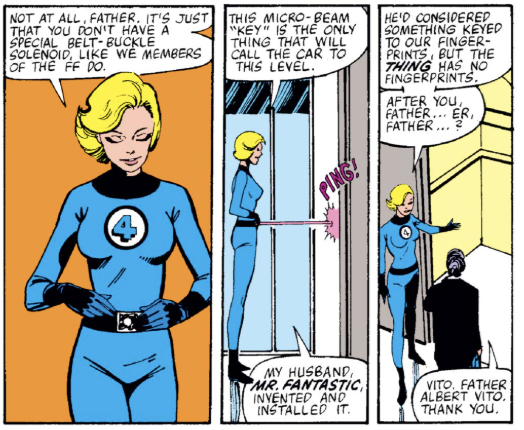
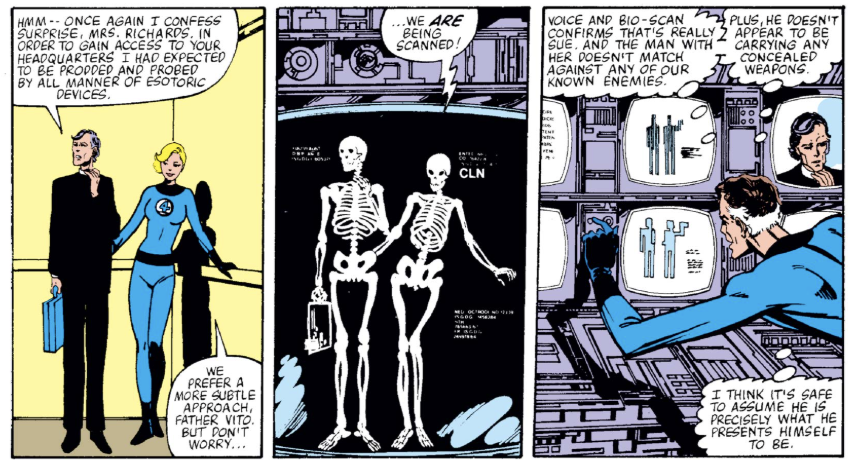
As mentioned, there is way too much explaining going on. This sequence feels very unnecessary:


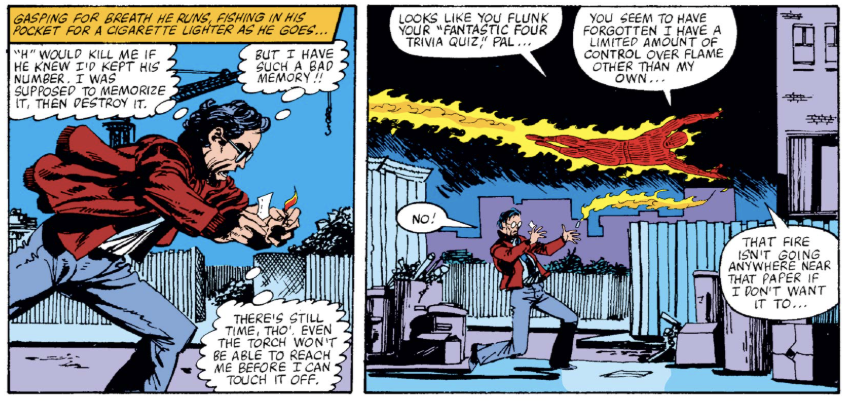
Byrne also seems to want to explain every facet of the Torch’s powers, even when they don’t make much sense for the situation. Here’s a bad guy running while trying to light a piece of paper on fire. Really? And of course, Johnny has to explain it all to him.

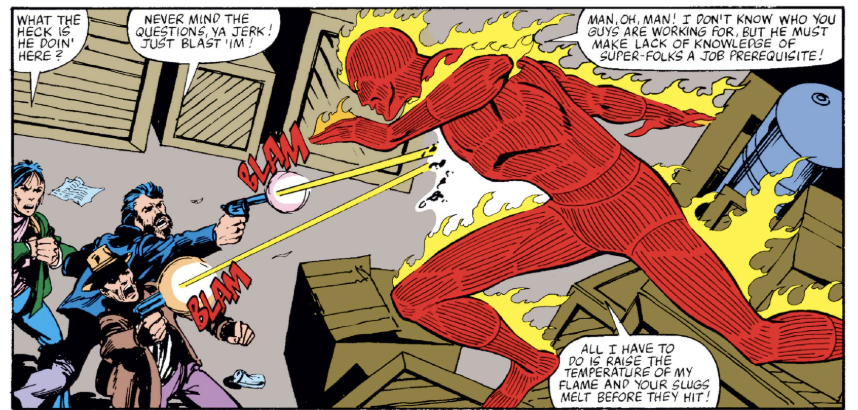
And here, Johnny says his heat can melt bullets before they can hit him. Bullets from a handgun travel at about 1,200 feet per second. I’m not sure how hot he would have to be to melt a bullet traveling that fast before it hit him, but I’m guessing it would be something like the surface of the sun.


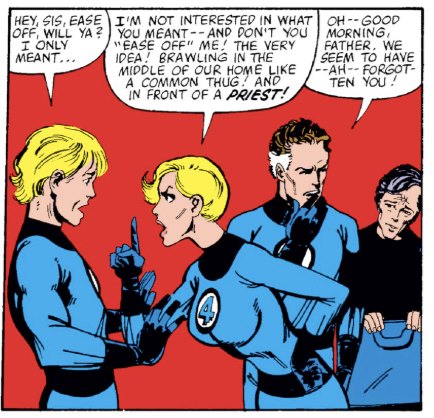
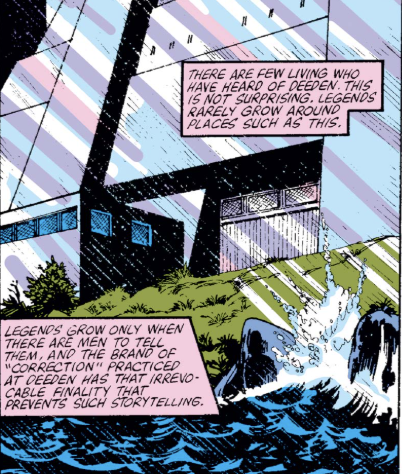
Lastly, Byrne, at least early in his scripting career, has a tendency to indulge in some pretty melodramatic writing.


Anything else?

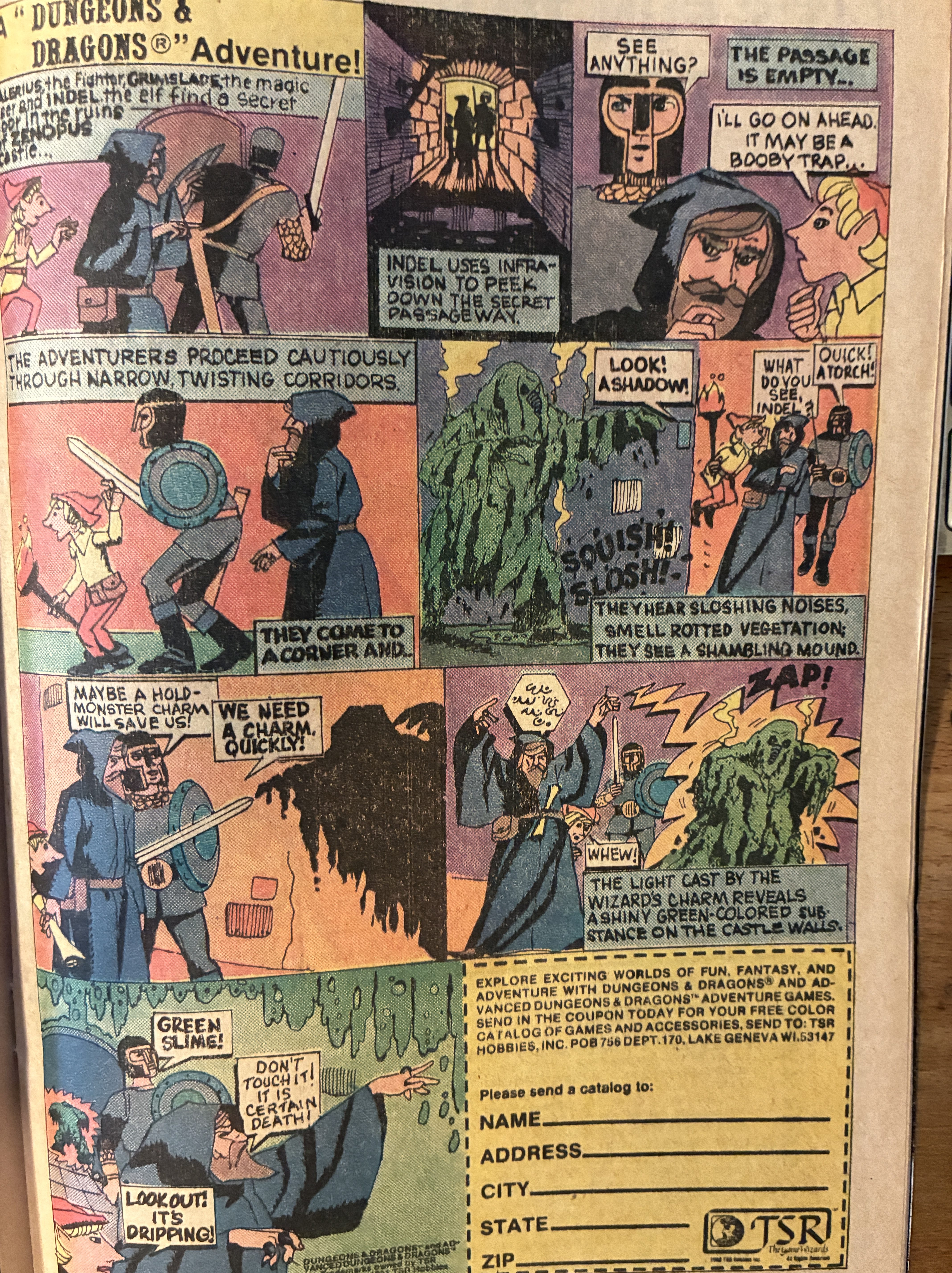
A strange ad for Dungeons and Dragons. You think they could have hired a professional comic artist.


Overall

Solid but unspectacular

“The World’s Greatest Comic Magazine!” Fantastic Four No. 232

Tags

, , , , , , , ,

Fantastic Four 232
“Back to the Basics!”
Published April 1981
Writer: John Byrne
Pencils: Byrne
Inks: Byrne (credited to “Bjorn Heyn”)
Letters: Jim Novak
Colors: Glynis Wein
Editor: Jim Salicrup
Cover: Byrne and Terry Austin


Synopsis

Diablo, the evil alchemist, launches a plan to subdue the Fantastic Four by attacking them with four elementals. The FF foil his plans by switching opponents and enlsiting Dr. Strange to track down Diablo.


What’s going on here?

After much anticipation, we’ve finally arrived at the John Byrne era, where we will remain for the next 60 issues or so. By now, there’s not much mystery about how Byrne ended up on the FF; after years of creative conflict with Chris Claremont, he wanted complete control over his own title (and apparently he’s still annoyed at Claremont, since he’s rewriting those comics in X-Men: Elsewhen). Given his childhood enthusiasm for the Lee / Kirby FF, it made sense for him to take on Marvel’s flagship title. To take on the writing, penciling and inking the FF, he dropped all his other projects, including writing and penciling Captain America (eventually he would work on multiple books again). As far as I can tell, this is first time writing and handling all the artwork since his time at Charlton comics.

It’s pretty clear clear Byrne wants to restore the Fantastic Four to the classic Lee / Kirby template — it’s even in the story’s title (“Back to the Basics”). In this issue, at least, there’s no Franklin, and Alicia only makes a brief appearance. Reed is back to his bossy self, and he concocts a scientific solution to defeating the bad guys. I also don’t think it’s an accident the FF fought elementals that are cognates of their own abilities (lest you forget: Reed = water, Sue = air, Ben= earth, Johnny = fire). I’m not sure how many fans jumped on board with this issue, but Byrne made it very easy for new readers to catch up. If this book came out today, it would be a No. 1 issue with a dozen variant covers.


One oddity is the inking is credited to “Bjorn Heyn,” not Byrne. According to the internets, in those days creators were discouraged from having so many credits on any one issue. Times have changed.
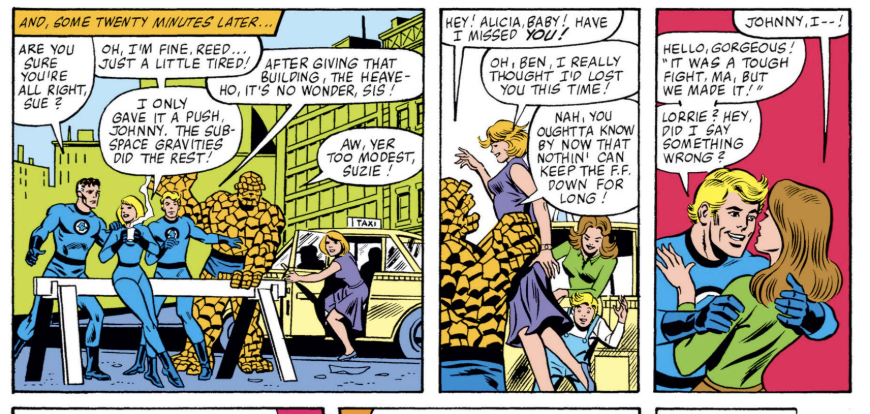
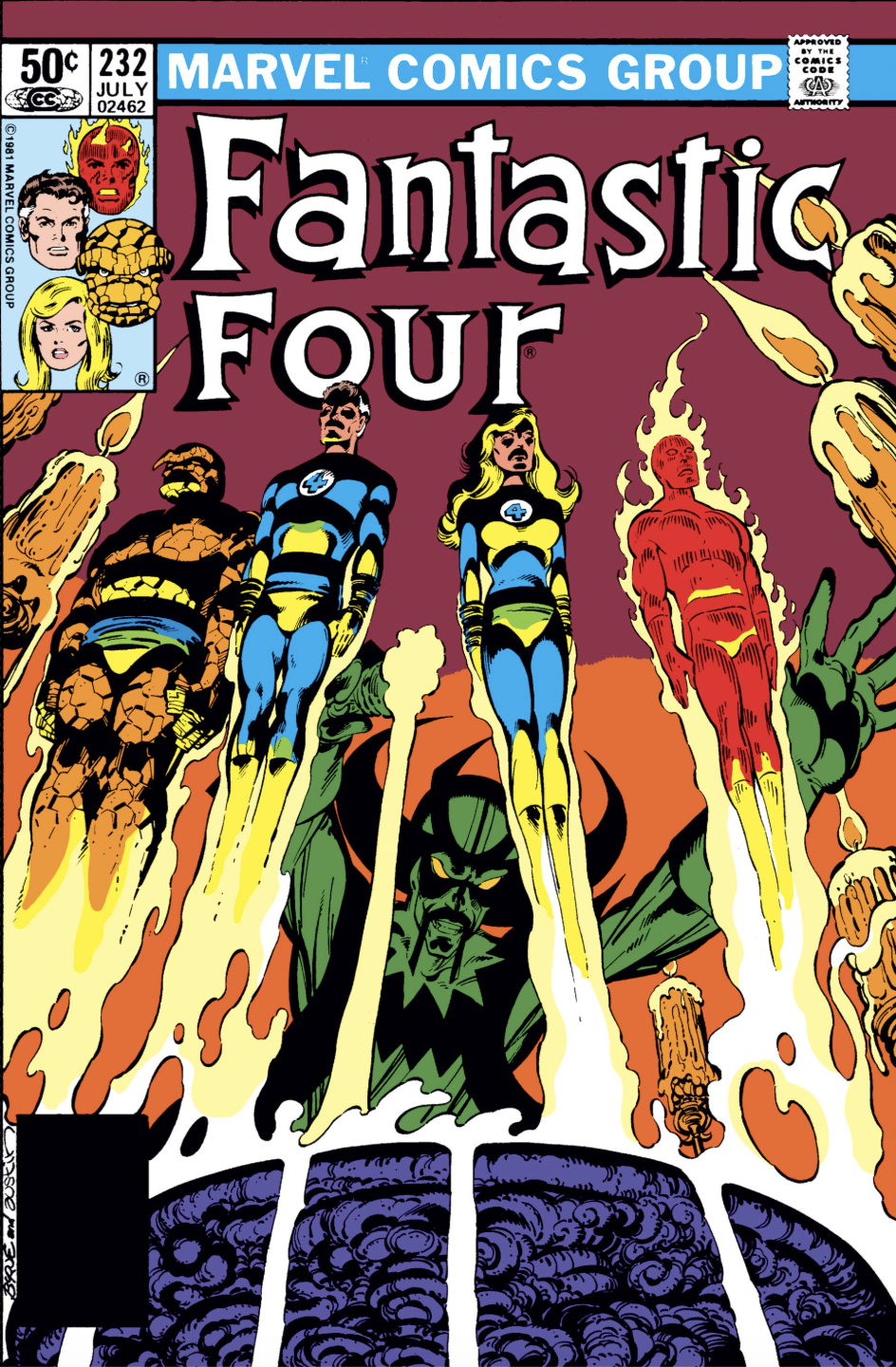
Terry Austin inked the cover, which looks great.


What I liked

It’s hard not to gush about this issue after so much mediocrity over the last few years. It’s not perfect (more on that later) but it’s a well told story, with terrific art and lots of fun touches. Diablo is an interesting choice of villain; he’s a throwback to the Lee / Kirby years but not as consequential as Dr. Doom or Galactus. You could see the Mole Man or Red Ghost in this story as well.

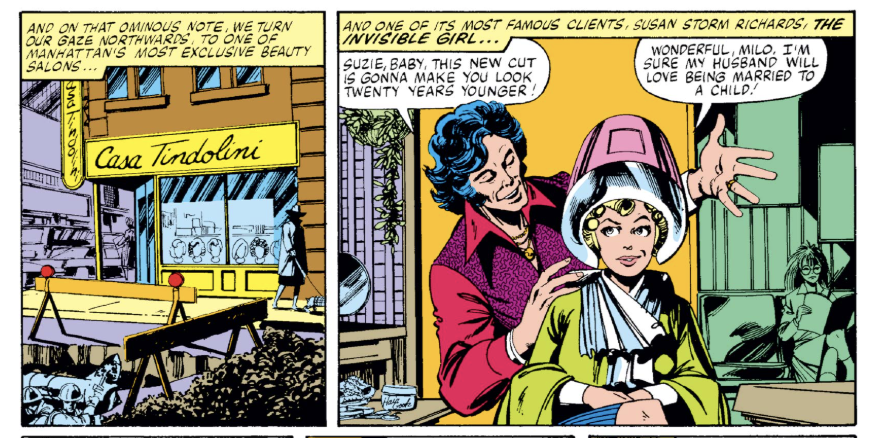
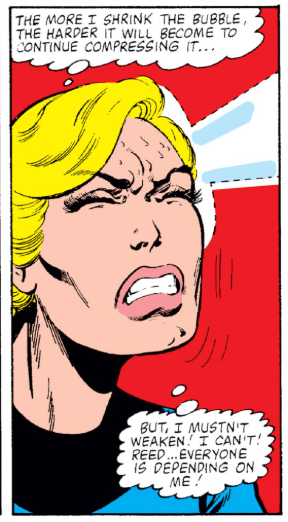
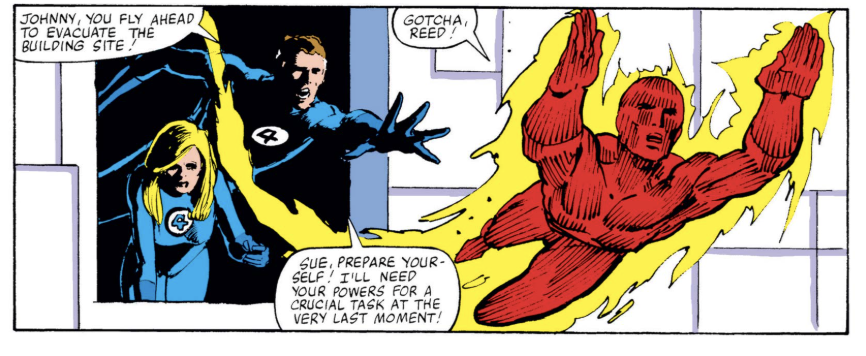
Like a lot of Lee / Kirby issues, this one starts with members of the FF out on the town, and as in many of those issues, Sue is doing something pointedly feminine (she’s usually getting her hair down or buying clothes). Byrne at least has a cheeky spin on the trope:


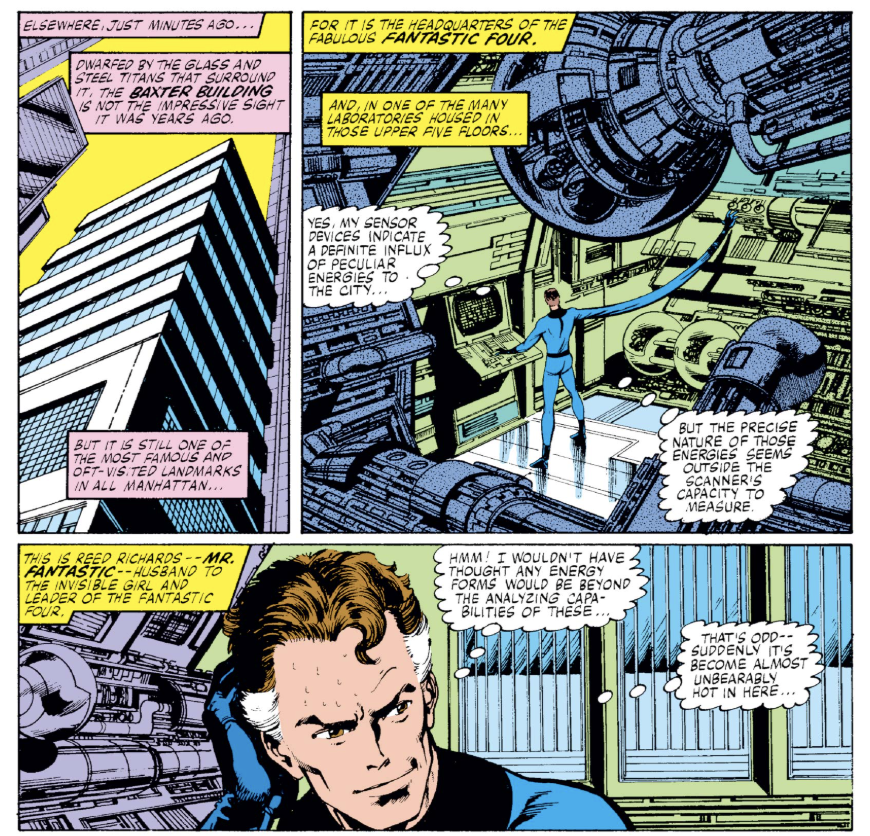
We also get a Kirby-like shot of Reed in his lab (and note his updating of the Baxter Building’s surroundings):


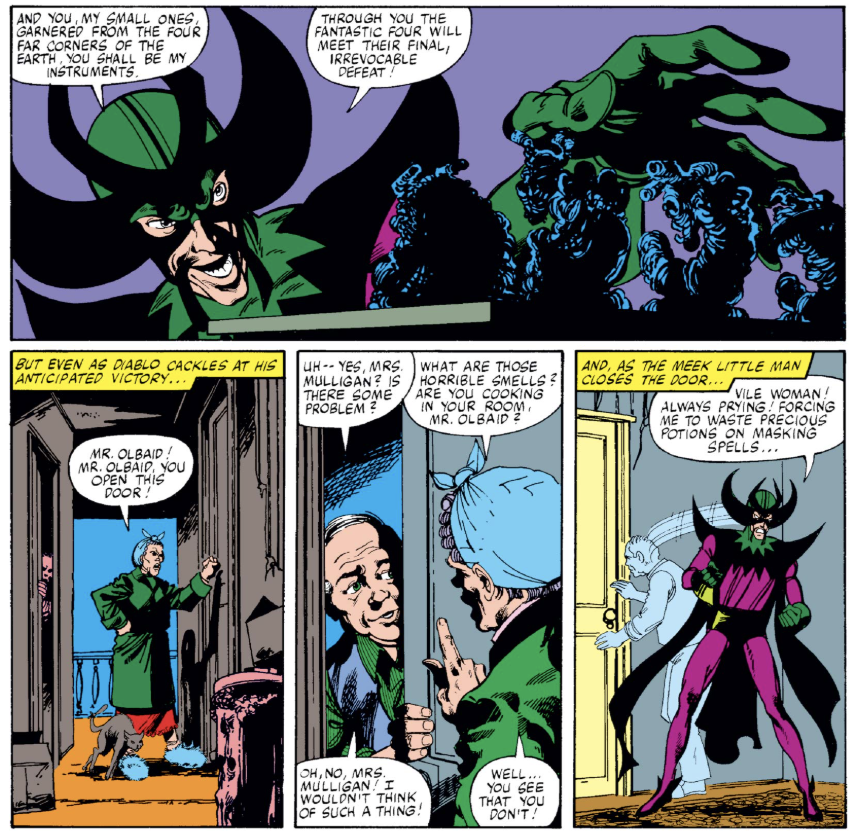
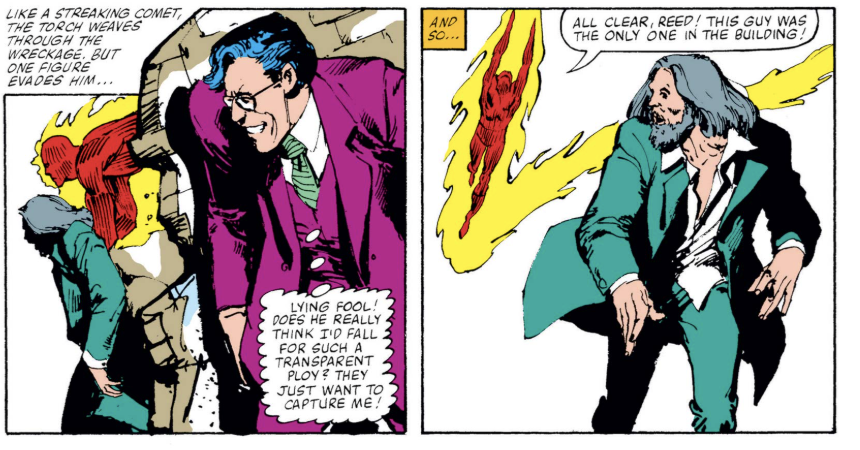
And a here’s a fun scene of Diablo in full Snidely Whiplash mode:


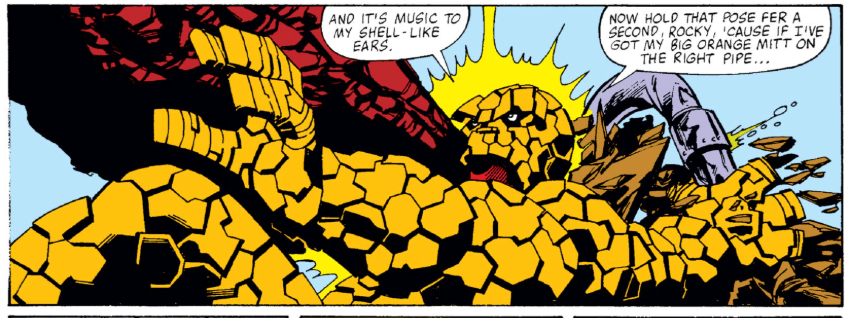
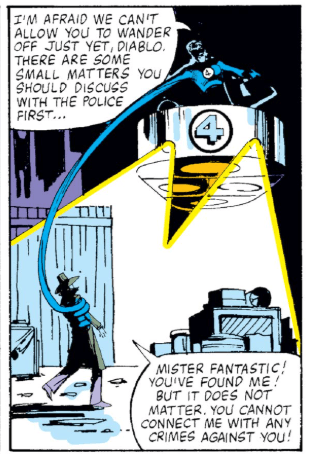
There’s a lot of striking panels throughout, and they hint at what’s to come. Here’s a sample of a few of them (one for each of the FF:


What I didn’t like

Byrne can at times resort to cliches (“shell-like ears” in the above panel will reoccur over and over) and be unnecessarily expository. Do we really need Sue to explain that she’s using her powers in a new way? And would she really call Ben “the Thing?” It feels like Byrne is bending over backwards for new (and very young) readers.


We also get a return of Reed-is-a-jerk, which I assume is Byrne’s attempting to reestablish the team’s hierarchy, but it is very unwelcome:


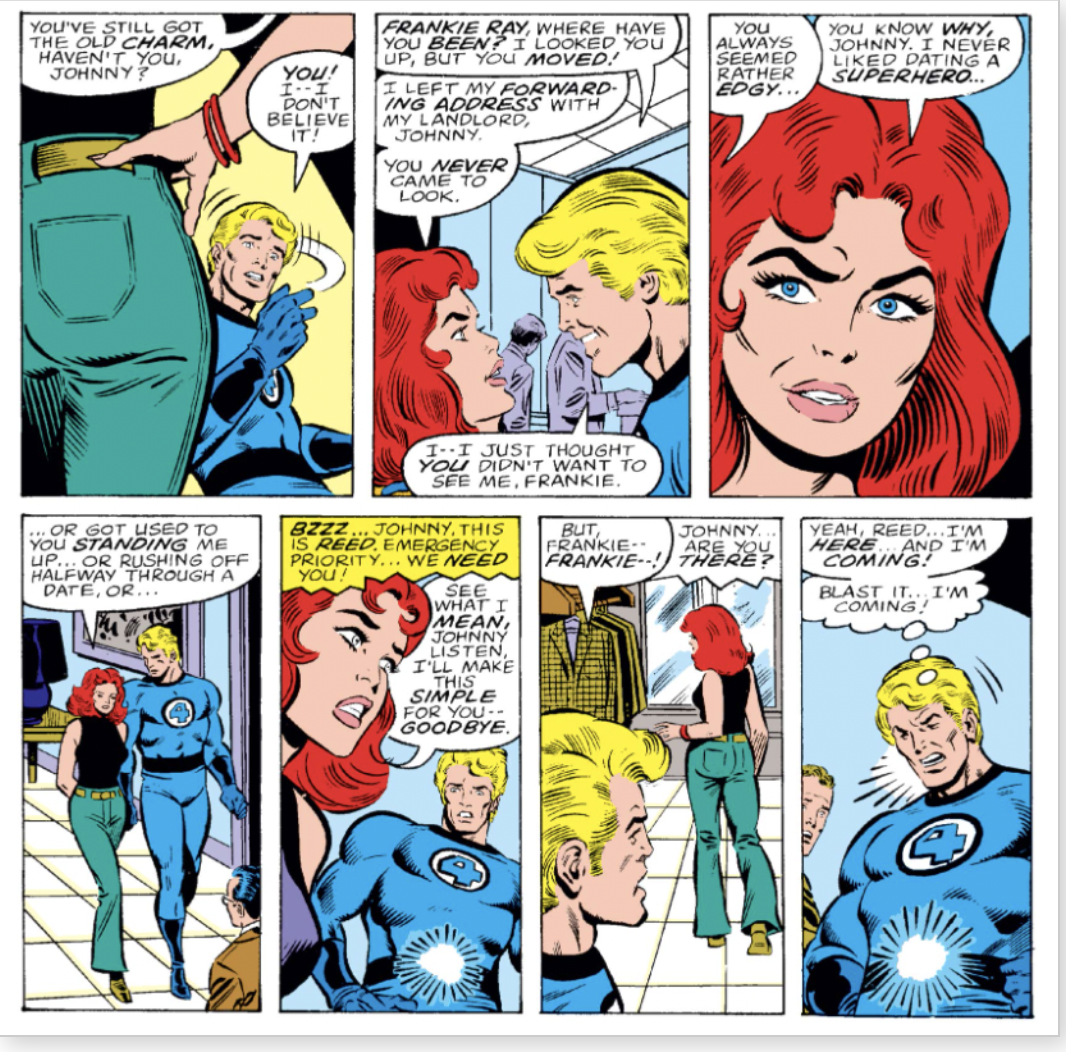
Byrne also brings back Frankie Raye, Johnny’s erstwhile girlfriend, which seems forced, given how she dumped him in issue 204:


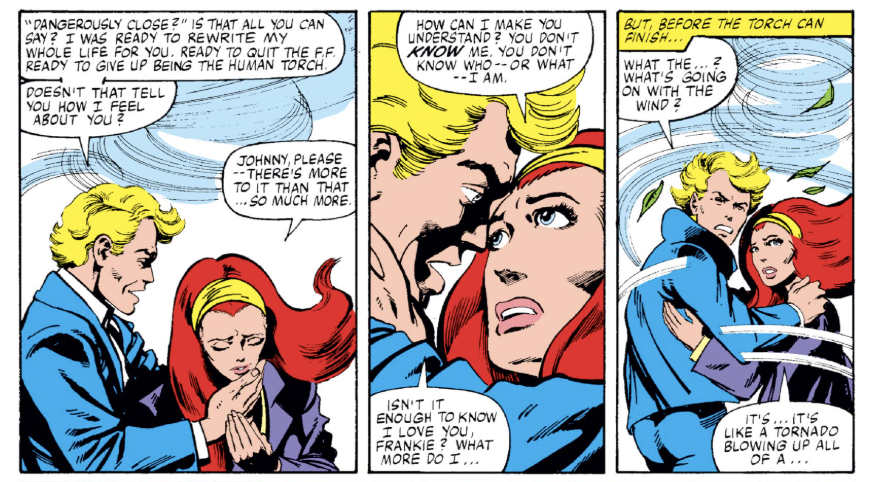
As we shall see, Byrne has plans for Frankie, and so wants her back in Johnny’s life, but this is pretty awkward (and melodramatic):


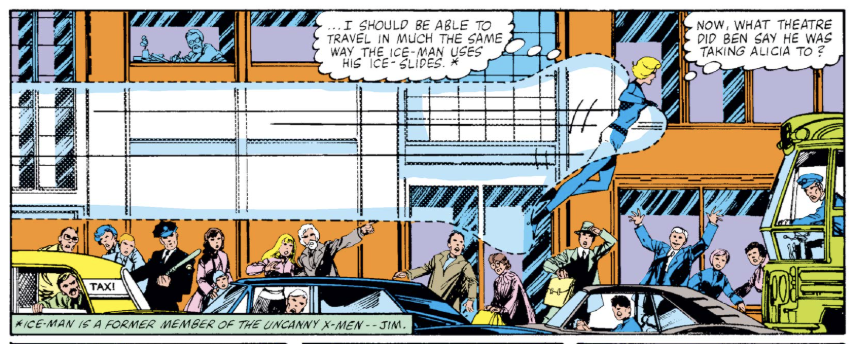
I’m not sure if this is the fault of Byrne or editor Jim Salicrup, but why do we need an editor’s note telling us who Iceman is:


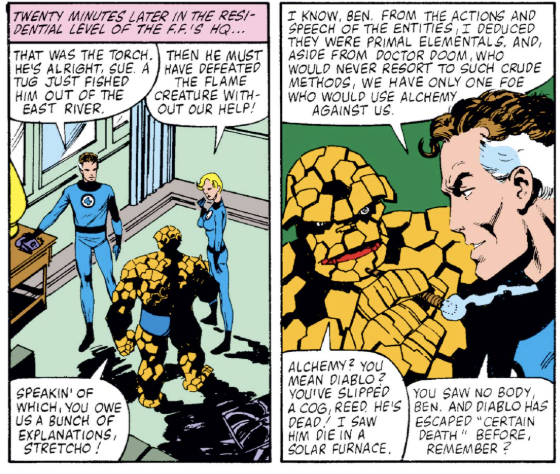
But we have to look up the issue when Diablo was apparently killed? (It’s FF 194)


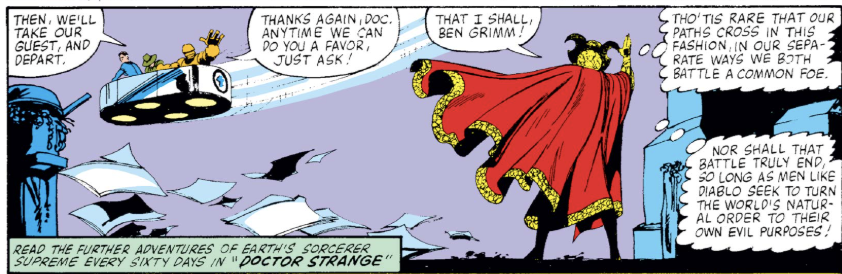
Lastly, I didn’t love Dr. Strange’s archaic speech (and thought) patterns. Did he talk like this in his own book back then?


Anything else?

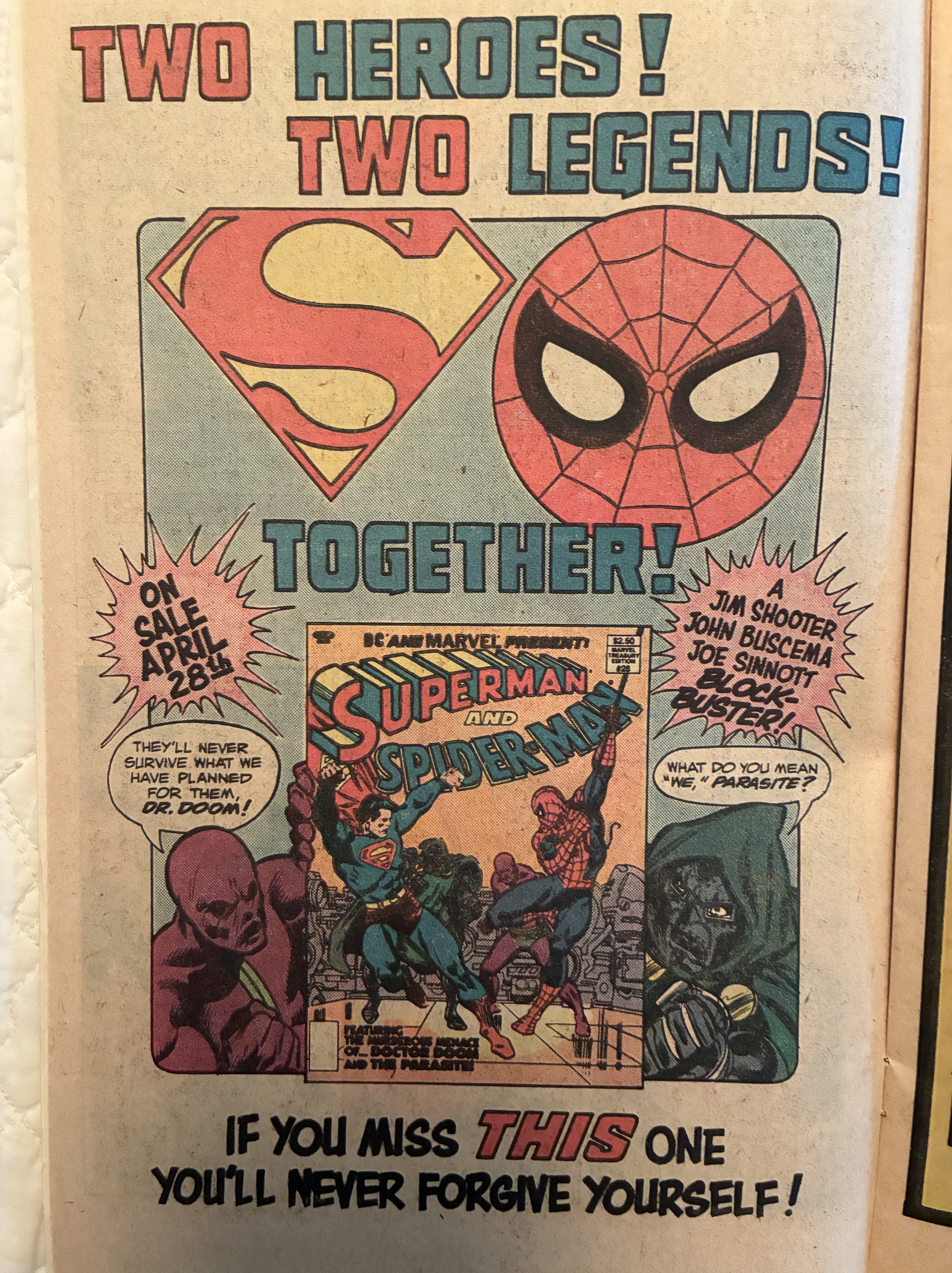
A house ad for the first Superman-Spiderman crossover (which I don’t think I ever read):


Overall

Happy days are here again!

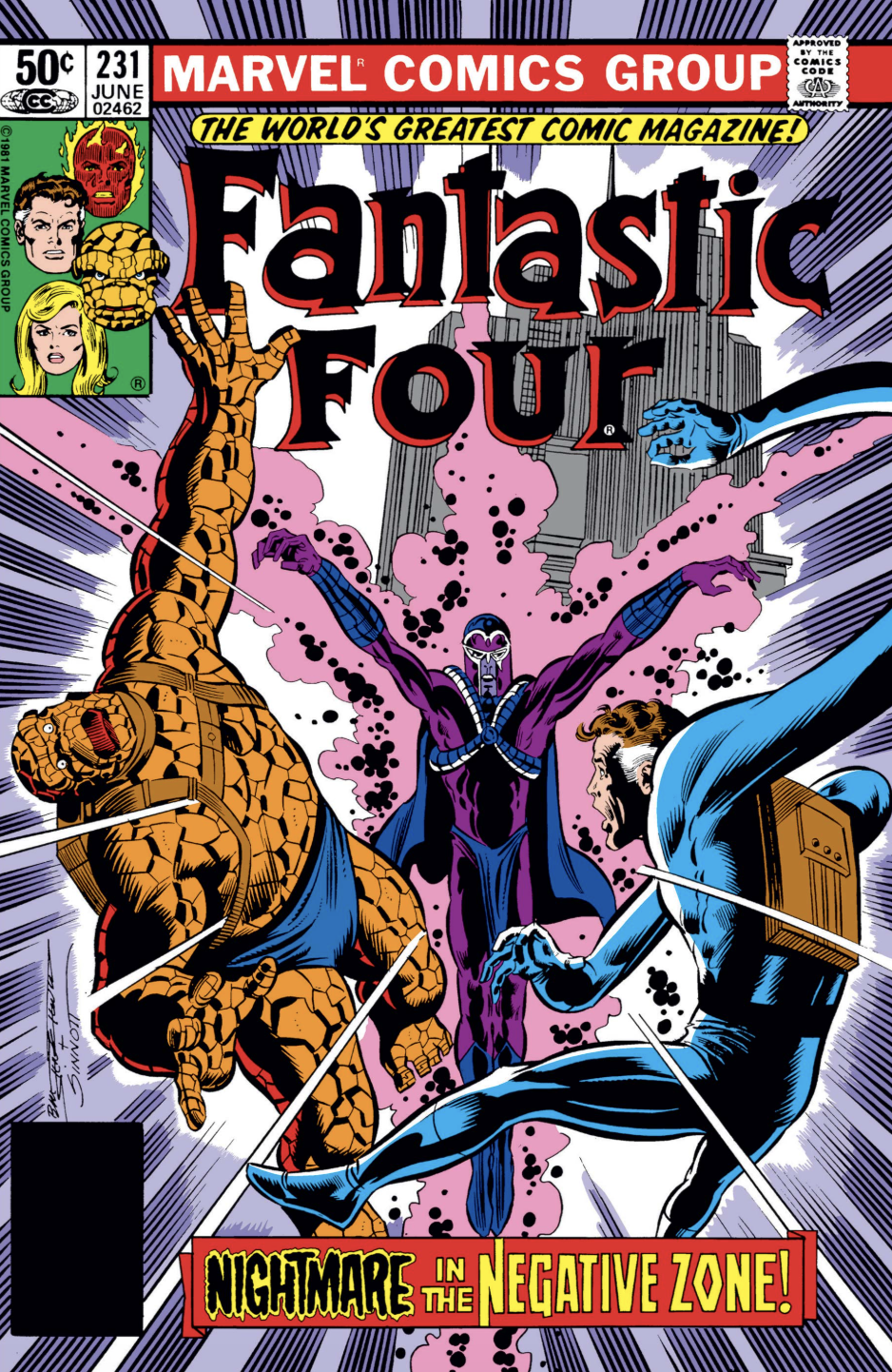
“The World’s Greatest Comic Magazine!” Fantastic Four No. 231

Tags

, , , , , , , ,

Fantastic Four 231
“In All The Gathered Gloom!”
Published March 1981
Writers: Doug Moench and Roger Stern (credited as “Gurland”)
Pencils: Bill Sienkiewicz and Al Milgrom (credited as “Moore”)
Inks: Joe Sinnott, Sienkiewicz and Frank Giacoia (uncredited)
Letters: Jim Novak
Colors: George Roussos
Editor: Stern (credited to Jim Salicrup)
Cover: Sienkiewicz and Sinnott


Synopsis

The Baxter Building is trapped in the Negative Zone with a small slice of Manhattan, whose residents blame the Fantastic Four for their predicament. As the FF try to steer their way back, they are attacked by Stygorr, a Negative Zone warlord. Meanwhile, Lew Shiner, a real estate developer stuck in the Negative Zone, rallies a mob to attack the Baxter Building. Mr. Fantastic devises a plan that both defeats Stygorr and Shiner and returns the missing piece of New York back to its own reality.


What’s going on here?

This is an interesting issue, for a number of reasons. I picked it up expecting the worst: The Doug Moench/ Bill Sienkiewicz run has been a disappointment and given this is their last issue the book, I expected them to mail it. And yet it’s a pretty good comic, with a crazy amount of plots and subplots that generate some real suspense and excitement. I was prepared to give Moench credit where credit was due until, researching this issue, I discovered it was both co-written and edited by Roger Stern (apparently Jim Salicrup was sick so Stern filled in as editor and rewrote some of the comic). It’s impossible to know from this distance who did what, but I’m going to guess the more enjoyable aspects were probably from Stern.

The comic’s art is similarly muddled. Most of the comic is laid out by Sienkiewicz, but only the first 21 pages are inked by Joe Sinnott. The next seven were finished by Sienkiewicz, and the last page, strangely, was penciled by Al Milgrom and inked by Frank Giacoia, neither of whom are credited (apparently, the credits were supposed to read (“& more” but it was rendered as just “Moore.”) The Milgrom/Giacoia art looks very out of place:


But the real story here is the unfettered Sienkiewicz. I’ve discussed before how Sienkiewicz said he appreciated Sinnott’s tutelage, but it’s pretty obvious how hemmed in he was by Sinnott’s conservative style. The pages that are all Sienkiewicz have a freedom and loose energy that foreshadows his work on the New Mutants. Here are a few examples:

The shame of it is we didn’t get to see Sienkiewicz unleashed until the last few pages of his run. With all due respect to Joe Sinnott, a Hall of Fame inker, his conservative style did Sienkiewicz no favors. As it happens, this is Sinnott’s last issue for some time.


What I liked


Along with the above-mentioned art, the story was better than most in recent months. Moench (or Stern) puts several stories in motion: The FF’s desperate struggle to return their slice of NYC to Earth, the menace and attack of Stygorr, the unhinged Shiner and his bloodlust, and lastly, Alicia, Franklin and Lorrie waiting at home for the FF’s return. It’s a lot, particularly because the main storyline involves some complicated (and mostly bogus) science, and it would have benefited from more space to tell the story properly instead of cramming it all into one issue. But the storylines come together nicely and it’s a pretty satisfying comic.

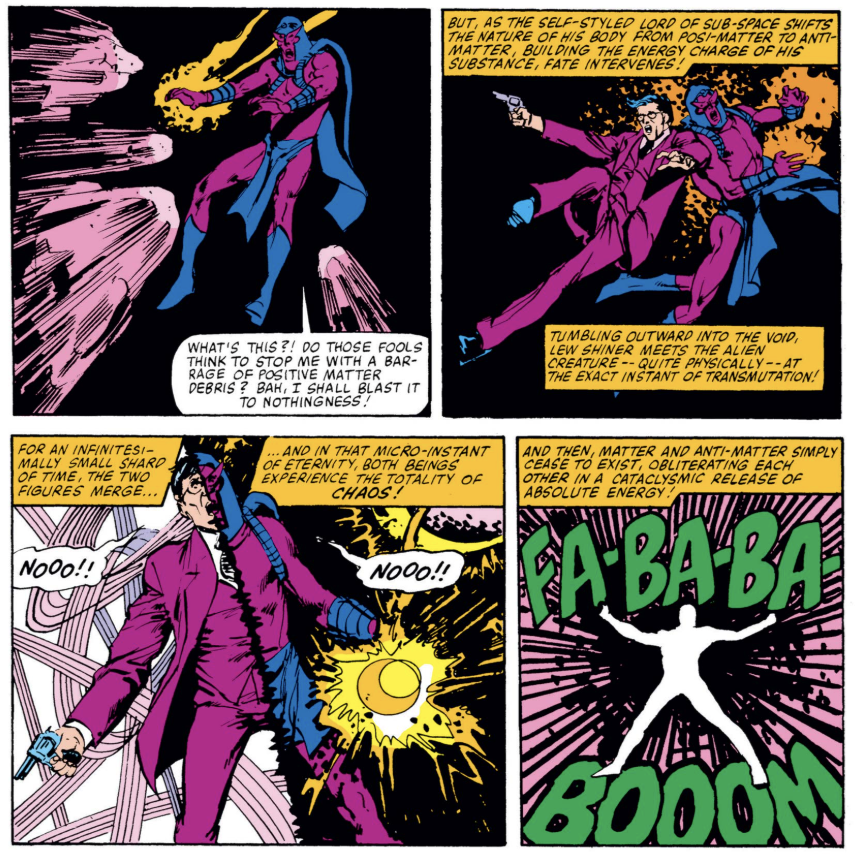
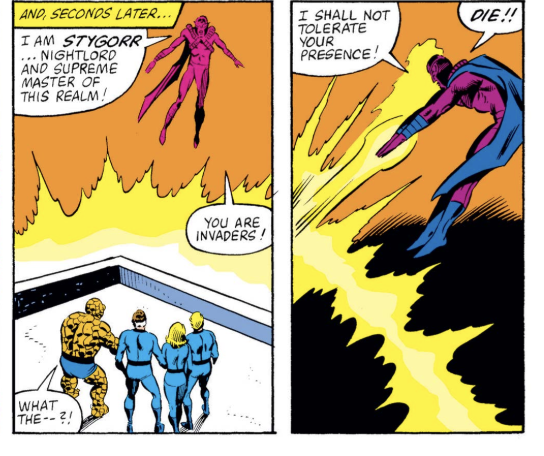
I thought this sequence, where the matter of Lew Shiner intersects the antimatter of Stygorr, was impressively dramatic:


I thought this was smart and revealing sequence, where Ben demonstrates his empathy for ordinary people:

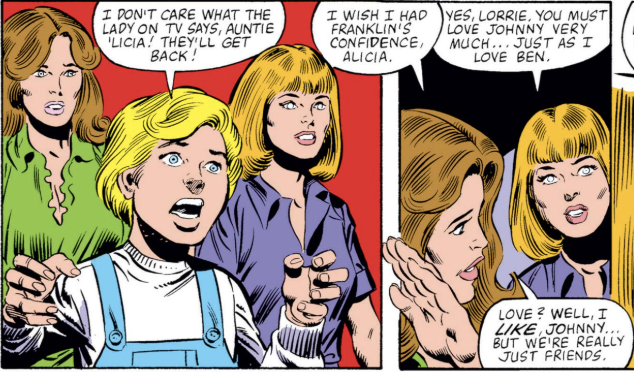
And I liked how Lorrie, Johnny’s girlfriend of the moment, just isn’t that in to him:


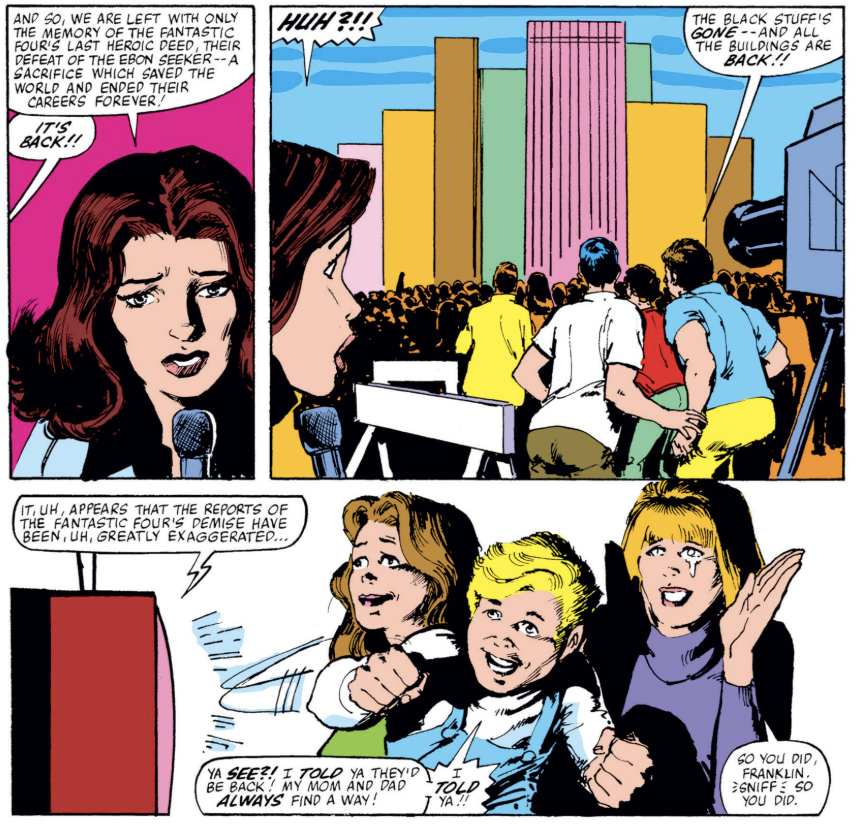
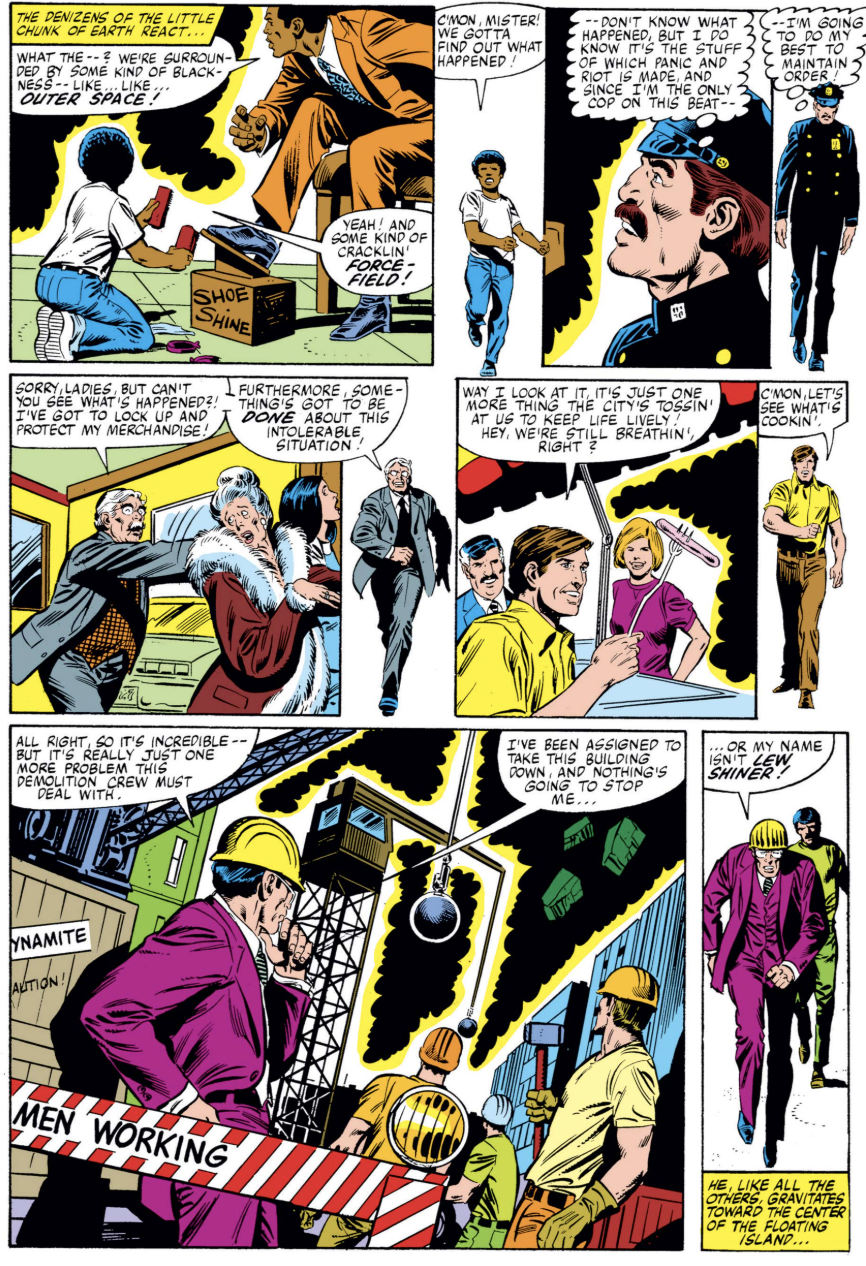
Lastly, this was a cool idea from Sienkiewicz, as the various types of New Yorkers set out to discover what happened to them:


What I didn’t like


Stygorr is a pretty silly character. By rights the role of Negative Zone baddie should be played by Annihilus, but since the villain is killed at the end, I suspect he was off limits and so Moench/Stern concocted this Stygorr. Like many villains, including Shiner above, he wears purple, and he speaks like a parody of a comic book bad guy.

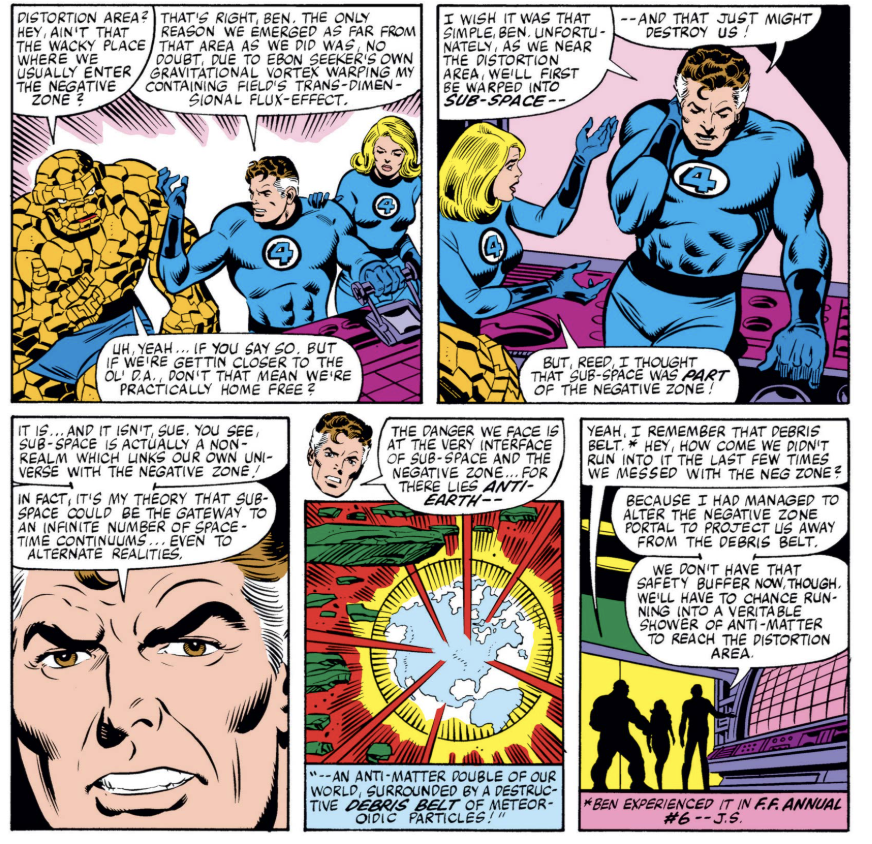
The whole comic revolves around very complicated distinctions between matter and antimatter, the Negative Zone distortion field, the FF’s containment field and something called sub-space. It’s mostly gobbledegook and Moench/Stern lays it on heavy:

Like a lot of the so-called science in comics, it’s best ignored.


Overall

Better than it had any right to be.


But wait, there’s more!

As I’ve said before, my initial goal for this blog was A, to read the entire Lee/Kirby run, B, re-read the Byrne run, and C, somehow survive the issues in between. I can now tick the last item off the list. The 129 comics (plus a few annuals) between Lee/Kirby and Byrne was a decided mixed bag, with some surprisingly enjoyable comics and an unfortunate about off crud.

Here’s how I rank the various main runs over that span (this doesn’t account for fill-in issues by other creators):

1, Len Wein/ George Perez / Joe Sinnott (issues 184 -192). A disappointingly brief run but features an early Perez firing on all cylinders and solid storytelling from Wein.

2, Archie Goodwin /John Buscema / Joe Sinnott (115 -118) Another too-short run. Goodwin is a great writer and you can’t go wrong with Big John Buscema.

3, Roy Thomas / John Buscema / Joe Sinnott (119, 126 – 132) Thomas had a number of runs with different artists over this span but these were his best stories.

4, Marv Wolfman / Bill Mantlo / John Byrne / Joe Sinnott (210-218) Wolfman’s stories didn’t always soar but it was a treat seeing Byrne’s layouts.

5, Stan Lee / John Romita / Joe Sinnott (103 – 107). Two words: John Romita

6, Roy Thomas / George Perez / Joe Sinnott (164 -167, 170, 172) An uneven stretch but some Perez gems in there. Plus it’s fun seeing Luke Cage in the FF.

7, Len Wein / Marv Wolfman / Keith Pollard / Sal Buscema / Joe Sinnott / Pablo Marcos (193 – 209) Consistent but unremarkable comics. Pollard occasionally shines.

8, Stan Lee /John Buscema / Joe Sinnott. A run that reminds you just how creative was Jack Kirby. (107 -114, 120 – 125)

9, Doug Moench / Bill Sienkiewicz / Joe Sinnott (219, 222-231) Less than the sum of its parts.

10, Gerry Conway / John Buscema / Rich Buckler / Ross Andru / Joe Sinnott (134 -152) Some real stinkers in here.


“The World’s Greatest Comic Magazine!” Fantastic Four No. 230

Tags

, , , , , , ,

Fantastic Four 230
“Firefrost and the Ebon Seeker”
Published February 1981
Writer: Doug Moench
Pencils: Bill Sienkiewicz
Inks: Joe Sinnott
Letters: Jim Novak
Colors: George Roussos
Editor: Jim Salicrup
Cover: Sienkiewicz and Sinnott


Synopsis

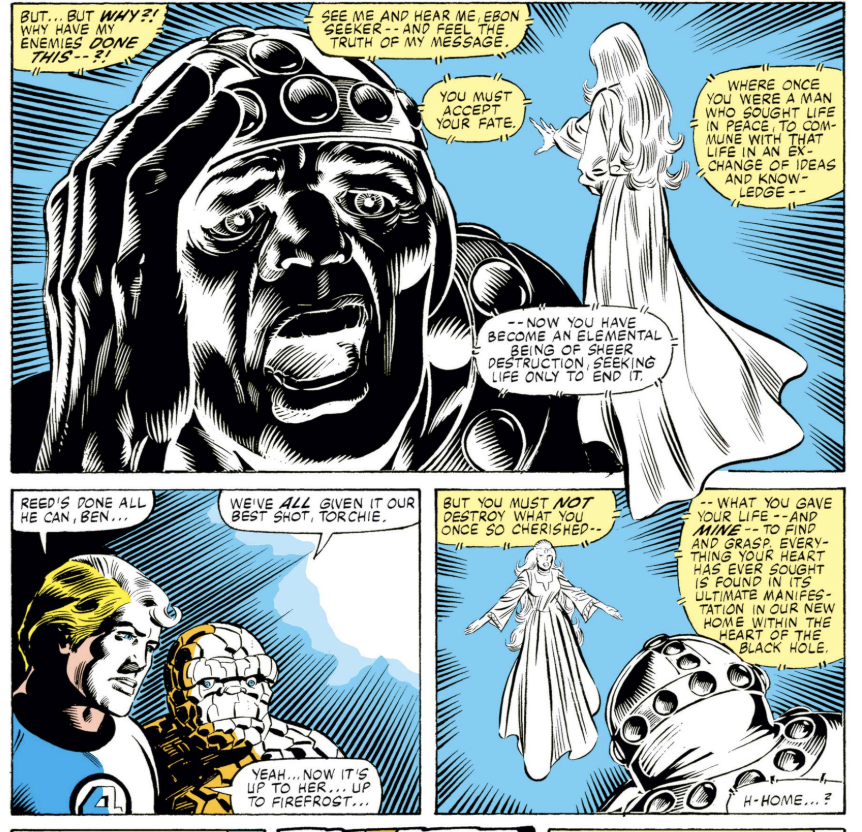
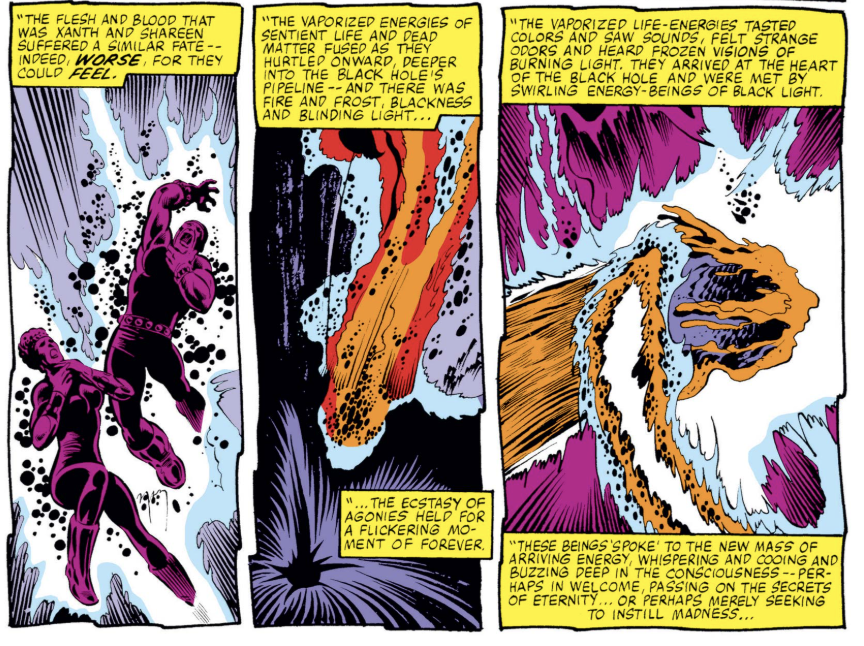
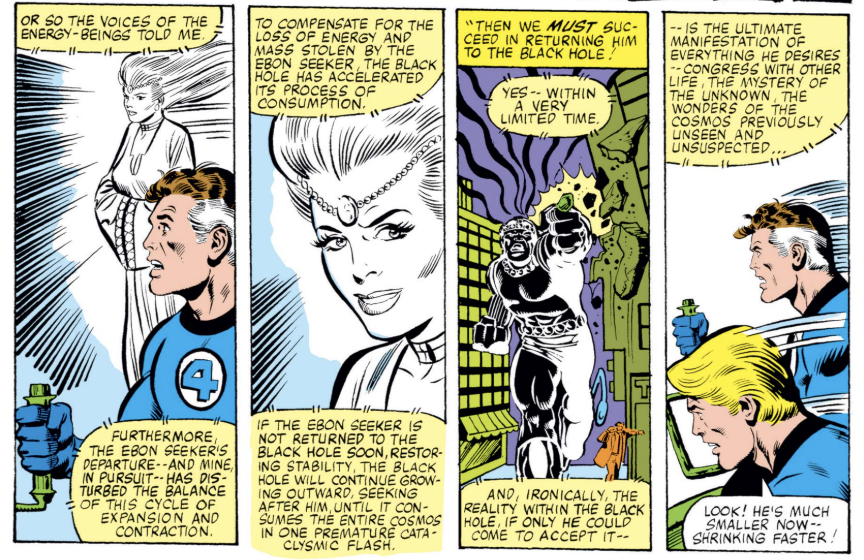
Firefrost, the Ebon Seeker’s companion, explains (at length) their origin — they were created in a black hole billions of years in the future and sent to the past — and tells the FF that if the Ebon Seeker’s energy is not returned to the black hole, it will trigger a new Big Bang, wiping out the universe. Mr. Fantastic siphons energy from the Negative Zone to the Ebon Seeker, whom Firefrost convinces to return to the black hole so he can be reborn as a creature of light, like her. The issue ends with the FF, the Baxter Building and some of New York stuck in the Negative Zone.


What’s going on here

If last issue was all action and no exposition, this issue is the opposite. The first eight pages of this 22-page comic are devoted to first a re-cap of the last issue and then a lengthy explanation of who these new characters are and how they came to be. Another several pages at the end delve into the science of black holes, the Big Bang and the Voyager space probe. It reminded me of the current FF run under writer Ryan North, who seems intent on including a science lesson in each issue.

As discussed previously, the Ebon Seeker is pretty much a straight swipe of Galactus, from his connection to the Big Bang to his hunger to destroy planets to his enlightened, silvery companion. What’s odd is Doug Moench devotes so much time and energy to establishing these characters, only to erase them at the end of the comic. Again, it seems that Moench’s heart is in horror and science fiction, and the Fantastic Four is just the vehicle for him to tell the stories he likes.

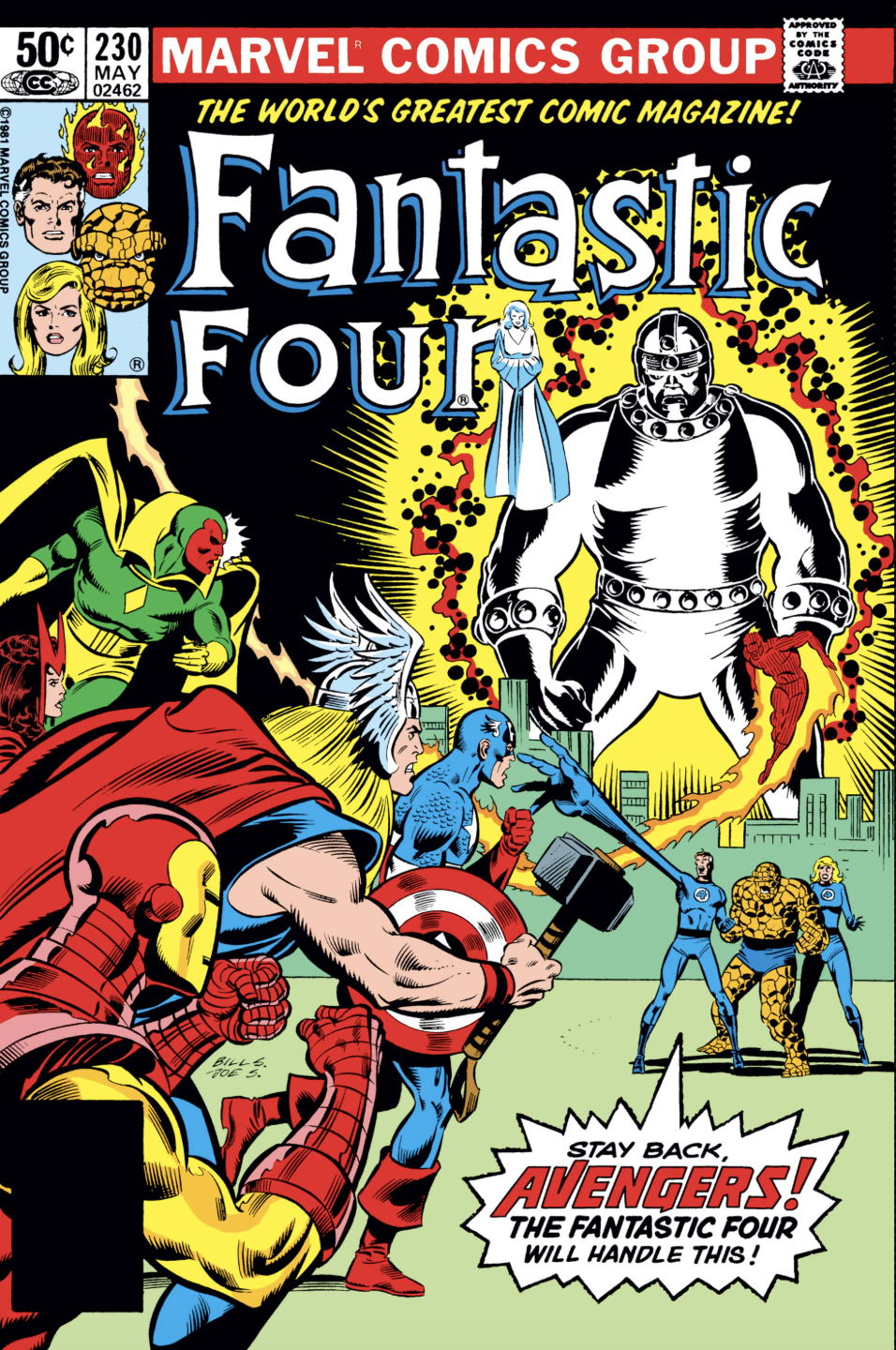
Also of note is the appearance of the Avengers, which is pretty brief despite their prominence on the (mediocre) cover. This used to be a pretty common feature of silver and bronze age Marvel: If there was some earth-threatening menace, other heroes would show up, or at acknowledge it. Now, a big, cataclysmic event is the basis for a annual crossover, which amounts to the same thing, but doesn’t reinforce that feeling of a shared universe in the same way.


What I liked

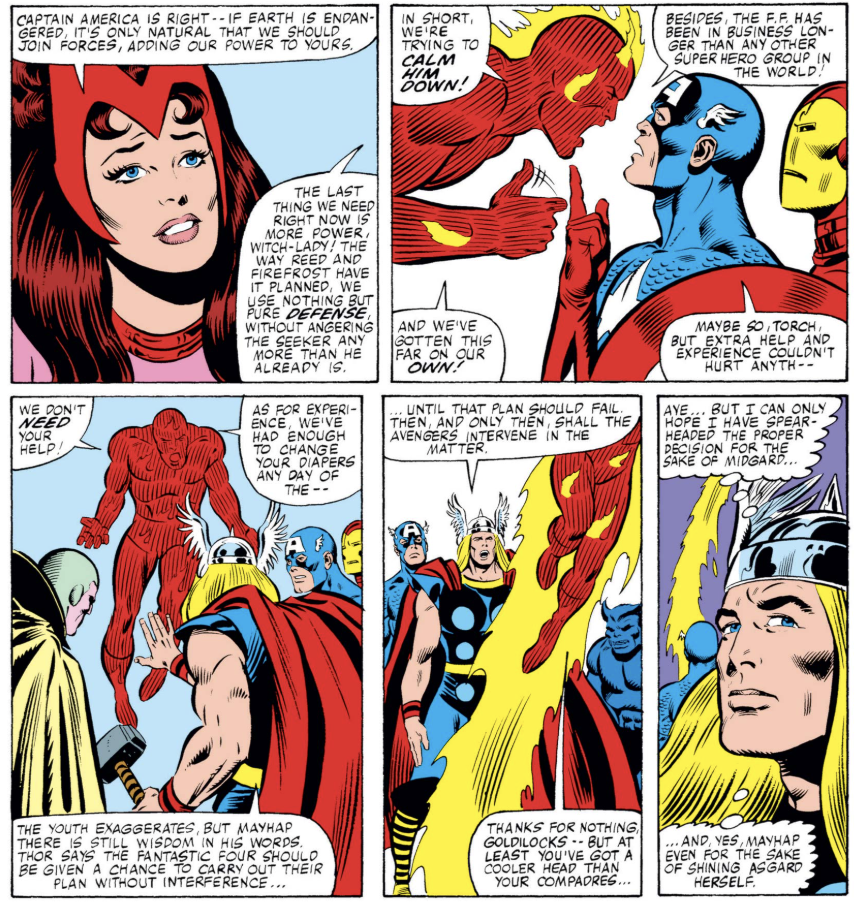
I did enjoy Johnny pulling rank on Captain America:

Given Moench’s predilection for plugging his other books in the pages of the FF, I half-expected to discover he was the new writer of the Avengers. In fact, the Avengers were then being written by assistant FF editor Bob Budiansky (and it was a pretty dismal period for the Avengers so they probably needed the help).

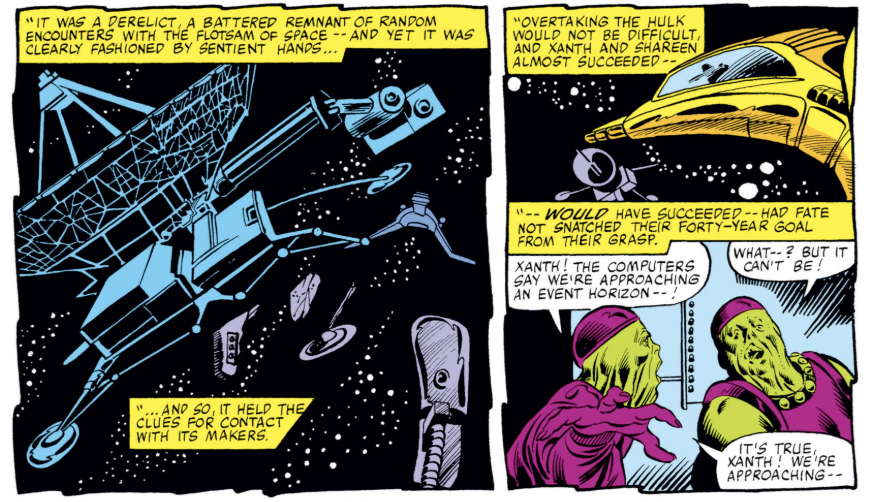
The aliens encountering the Voyager probe far in the future was a nice touch:


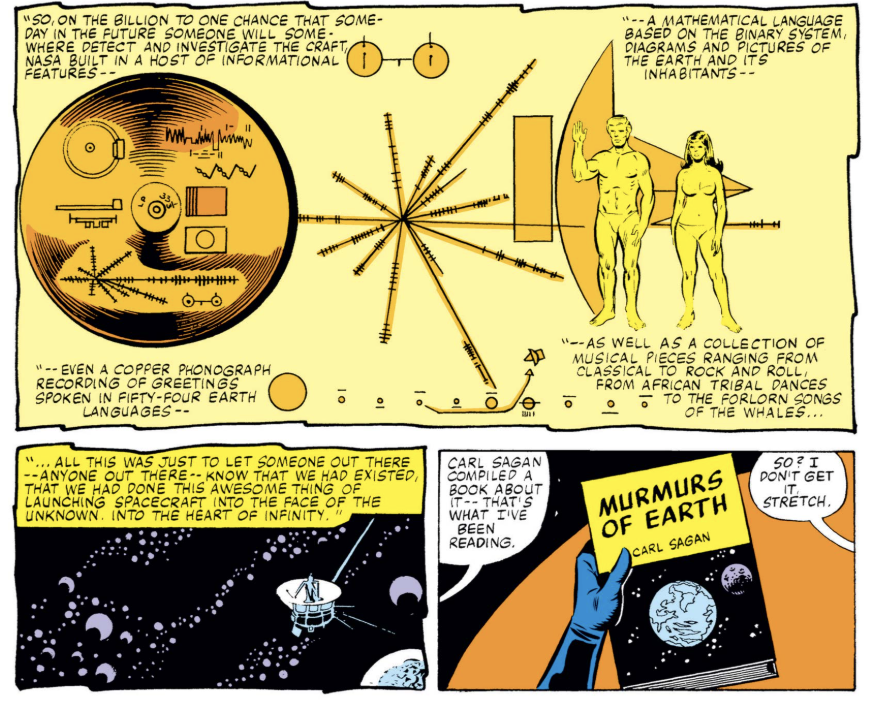
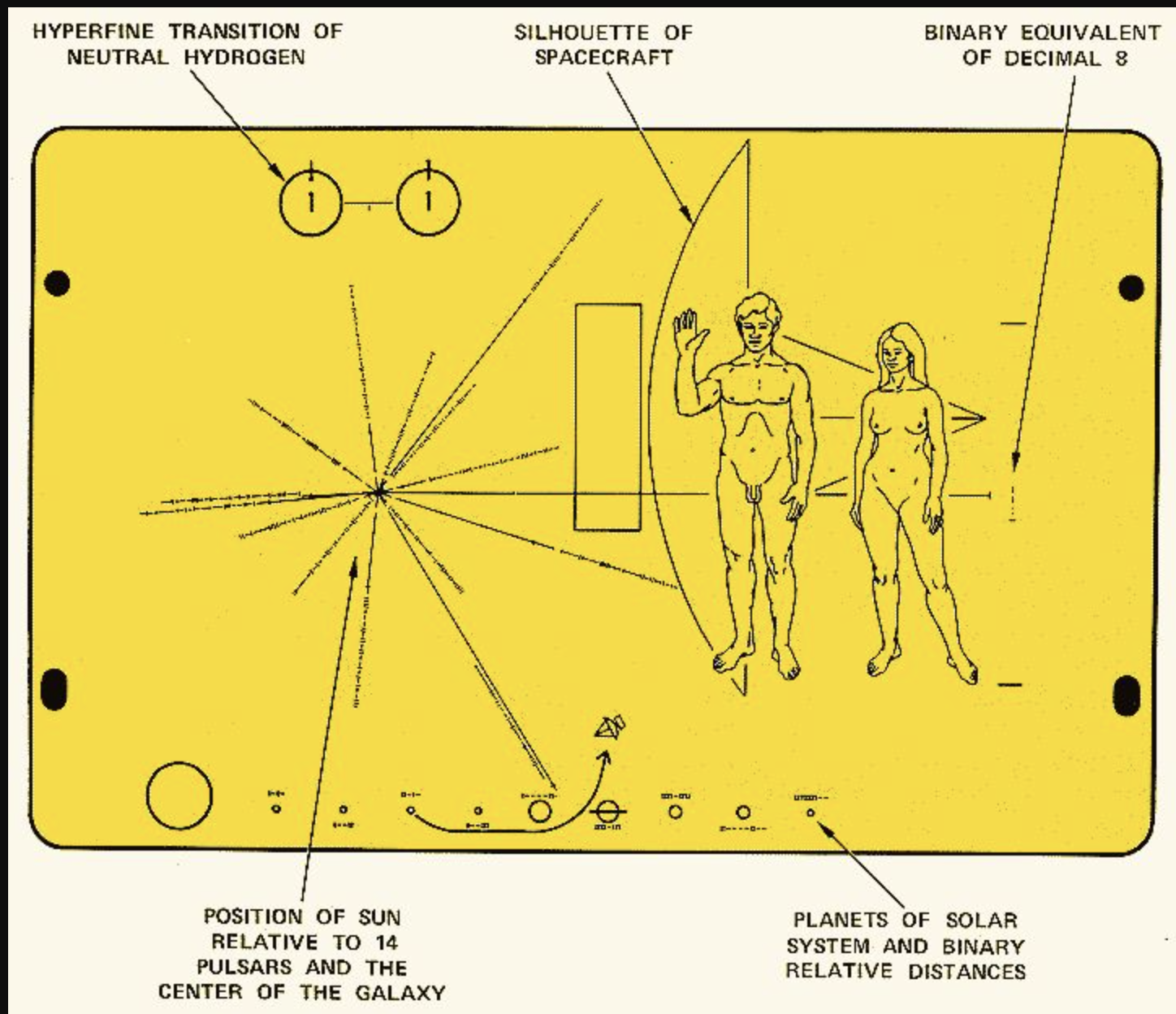
Of course, the famous golden recording and image on theVoyager probe — launched in the hope of humanity finally meeting alien life — doesn’t make much sense in the Marvel universe, where encounters with aliens happen monthly. For that reason, I was of mixed minds about this sequence, with Read reading a book by Carl Sagan about the Voyager recording. One would suspect Reed and Sagan were colleagues, and Reed — who has probably encountered more aliens than anyone else on Earth — would have been consulted in the recording.


Also, the the man and woman were buck naked on the real image:


This was mostly a humdrum issue for Bill Sienkiewicz and Joe Sinnott, but I liked this sequence:


What I didn’t like

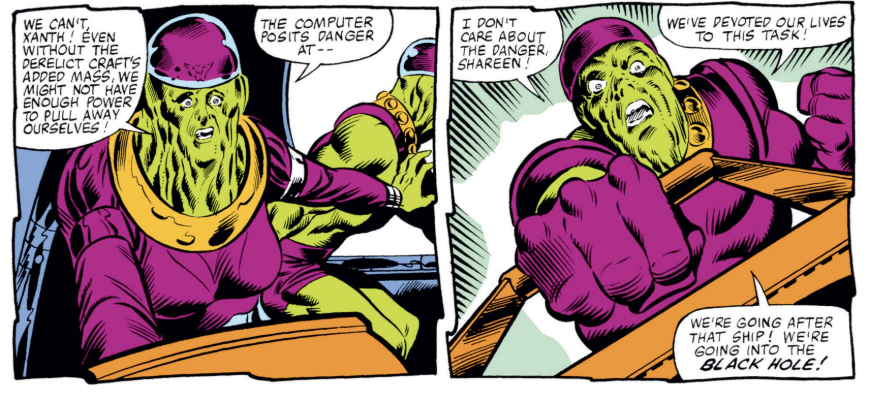
The explanation of the Ebon Seeker and Firefrost’s origin was hopelessly convoluted and nonsensical. They entered a black hole, encountered “energy beings” there and somehow emerged with new forms and powers. For a writer who seems interested in hard science, Moench seems willing to totally disregard basic physics to suit his story.


Also, why do the aliens — who are green and lumpy — become human-like after their transformation?


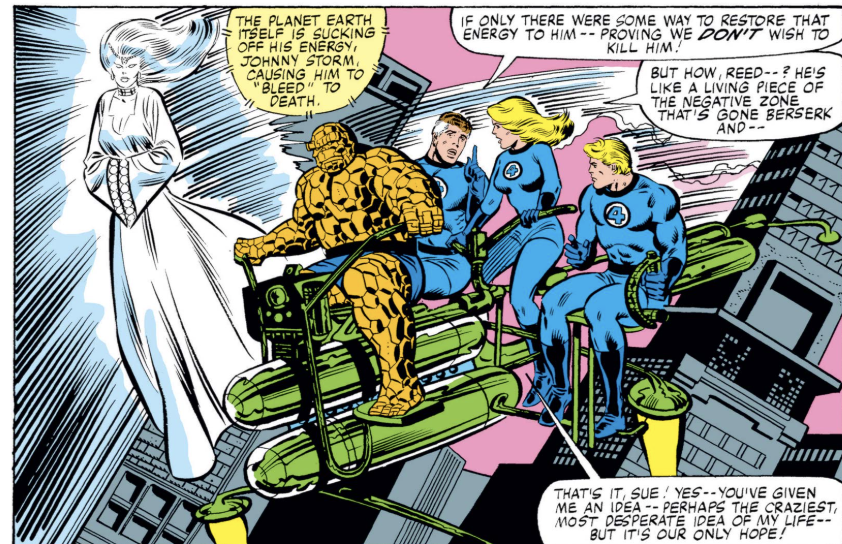
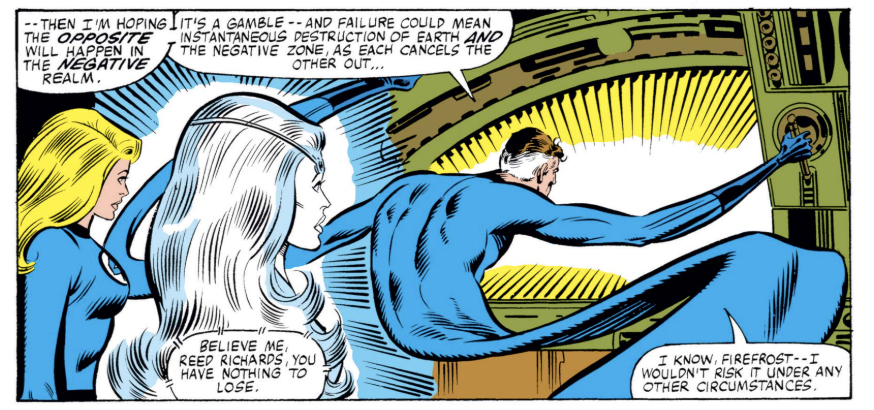
Firefrost seems pretty nonchalant when she informs Reed the universe is going to be destroyed:


Likewise, we get all of one panel for Reed to explain his gambit may risk the end of Earth:


Anything else?

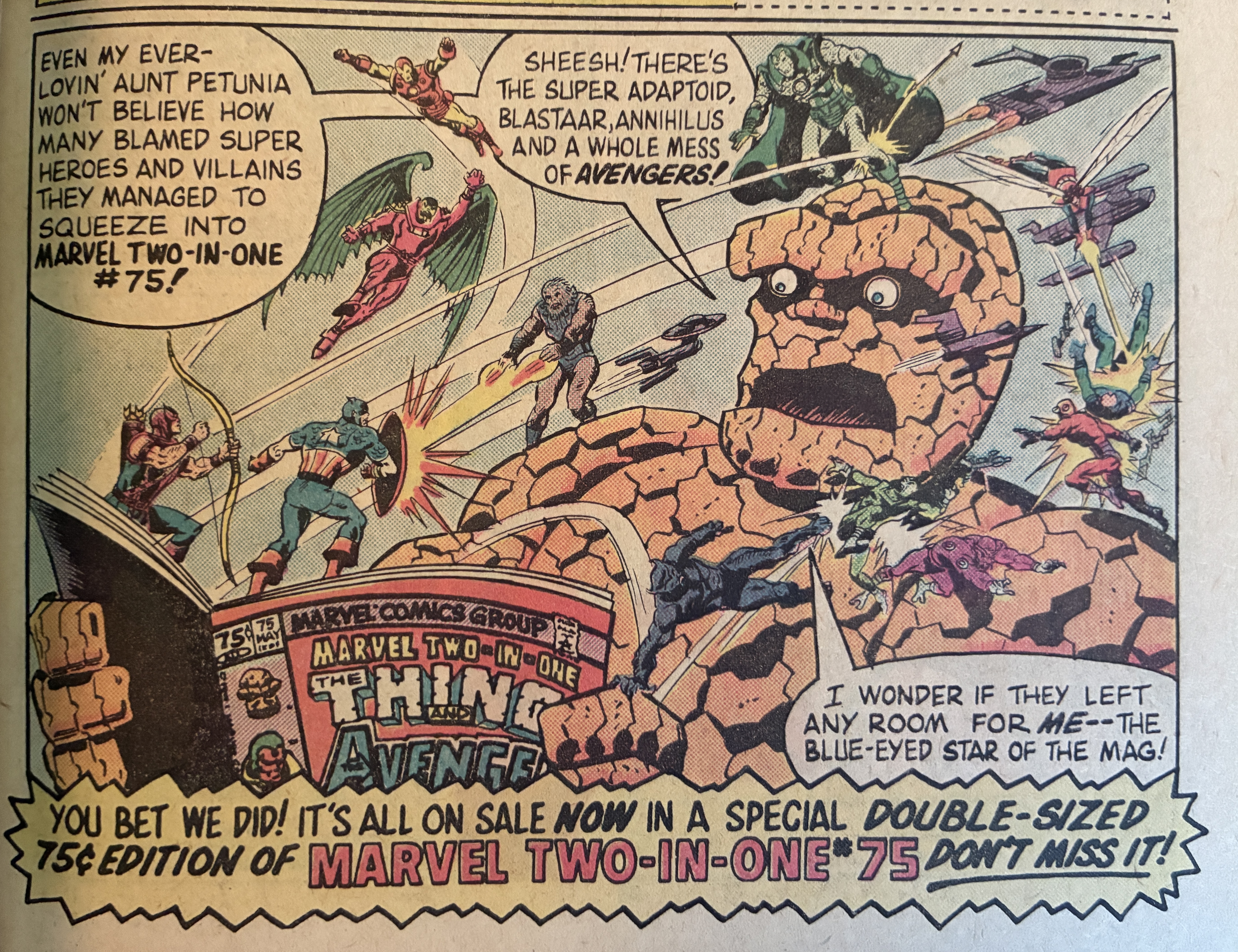
A house ad for Marvel Two-In-One. That comic looks a lot better than this one.


Overall

A mess

“The World’s Greatest Comic Magazine!” Fantastic Four No. 229

Tags

, , , , , , ,

Fantastic Four 229
“The Thing From The Black Hole”
Published January 1981
Writer: Doug Moench
Pencils: Bill Sienkiewicz
Inks: Joe Sinnott
Letters: Jim Novak
Colors: George Roussos
Editor: Jim Salicrup
Cover: Sienkiewicz and Sinnott

Synopsis

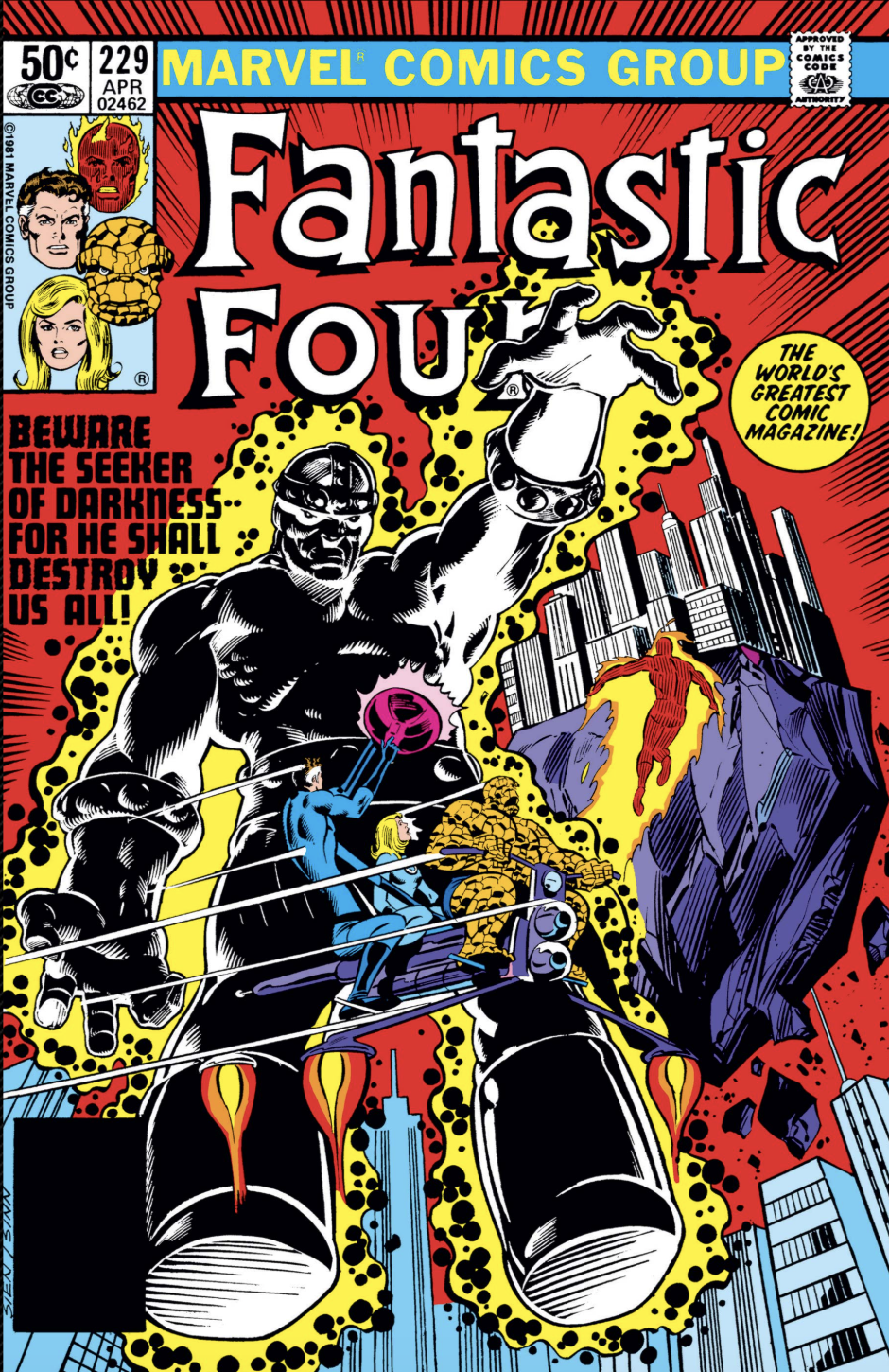
An ordinary day in New York for the Fantastic Four is interrupted by a monstrous space creature with incredible powers derived from a black hole. The FF battle the creature, called the Ebon Seeker, but are defeated and are left in a lightless region where they are met by Fire Frost, companion to the Ebon Seeker.


What’s going here?

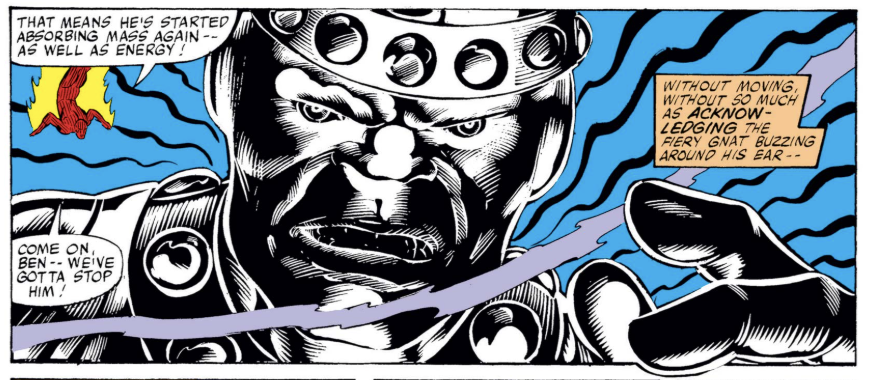
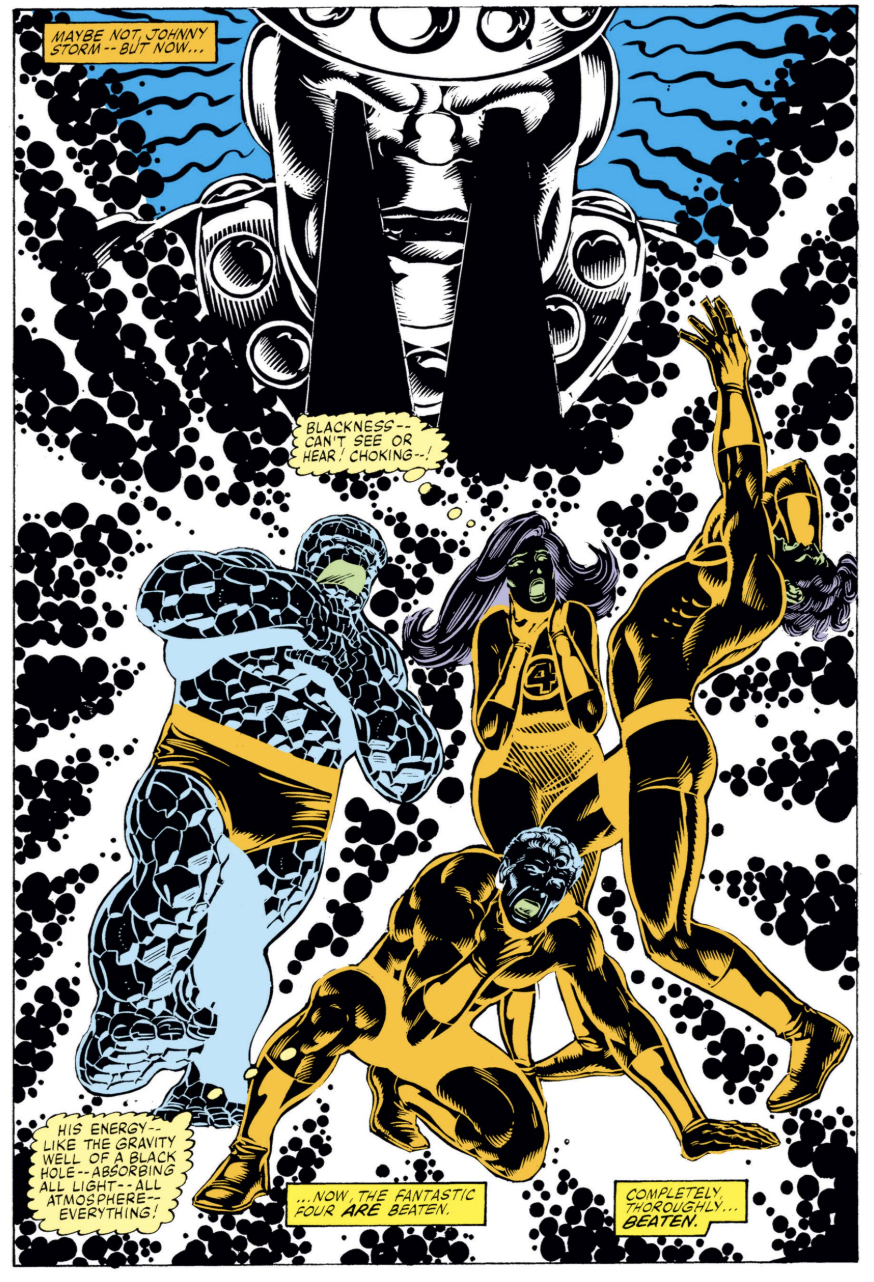
Another Doug Moench issue, another retread of old ideas. In this case, the parallels to the first appearance of Galactus seem pretty obvious. What redeems this issue (sort of) is the amazing black-and-white rendering of the Ebon Seeker. I assume this is largely the work of Joe Sinnott, since Bill Sienkiewicz is only credited with layouts, but I’m only guessing. It’s a powerful effect and it’s more impressive in the context of its era, when coloring wasn’t as sophisticated as it is now, and virtually every comic was rendered in combinations of the same four colors. I think it looks more impressive on the original page than in the Marvel.com reproduction. Here is the Ebon Seeker’s first appearance from each:


Given that the Ebon Seeker is anchoring a multi-issue story, which is rare for Moench, I imagine he was hoping to introduce a major new FF villain but the character appears just once more in subsequent decades.


What I liked

The comic is almost entirely a fight scene, and Sienkiewicz and Sinnott deliver some great action sequences and panels:


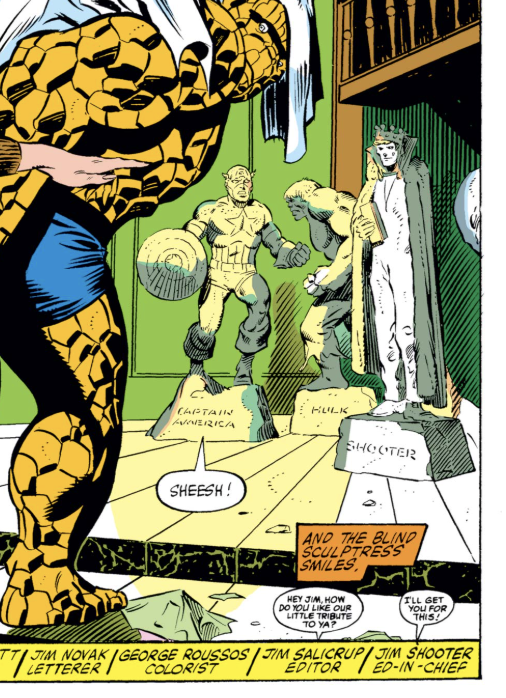
There was a fun detail in the credits, with Jim Salicrup “asking” Jim Shooter what he thinks of Alicia’s sculpture of him (I don’t know the backstory but I’m guessing Shooter’s grandiosity, which became more pronounced later in his Marvel tenure, was already an issue):


What I didn’t like

The narrative is boring and derivative, and for most of the issue we have no idea who the Ebon Seeker is or what is motivating him. When we find out — he wants to destroy Earth — it has no impact on the reader because we’ve seen this movie before. It’s more evidence that Moench really didn’t know what he was doing with this comic.

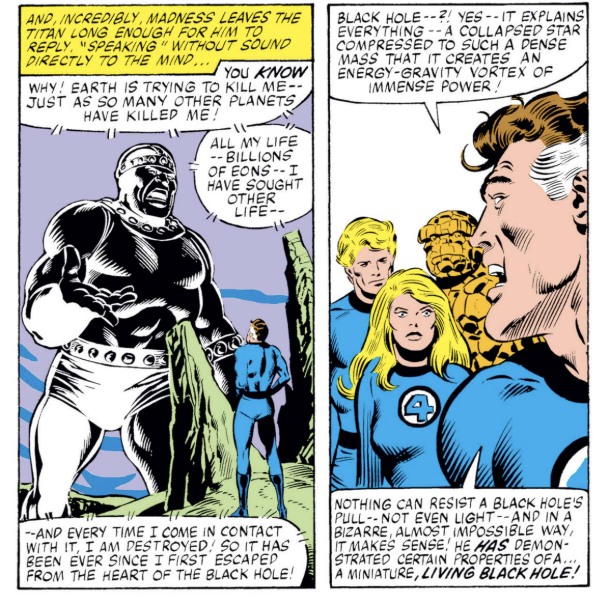
Further, the explanation of the Ebon Seeker’s powers — he is a living black hole — is nonsensical.


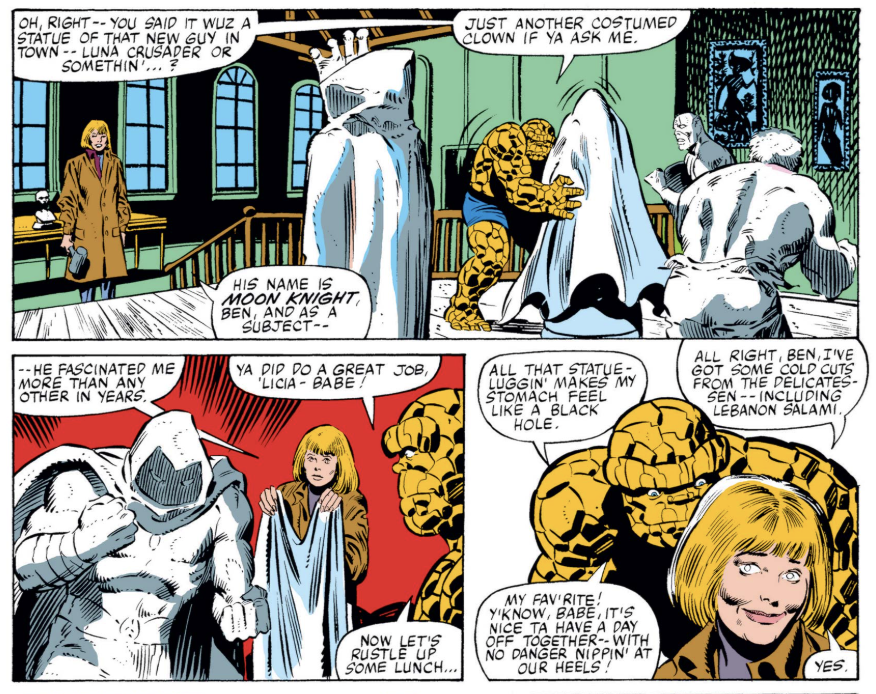
I’ve pointed out previously how Moench doesn’t miss an opportunity to plug the other comics he’s writing, but this might be his most blatant example:


New Yorkers turn against the Fantastic Four and riot! Why? Who knows? It’s never explained.


Overall

Impressive art. That’s about it.

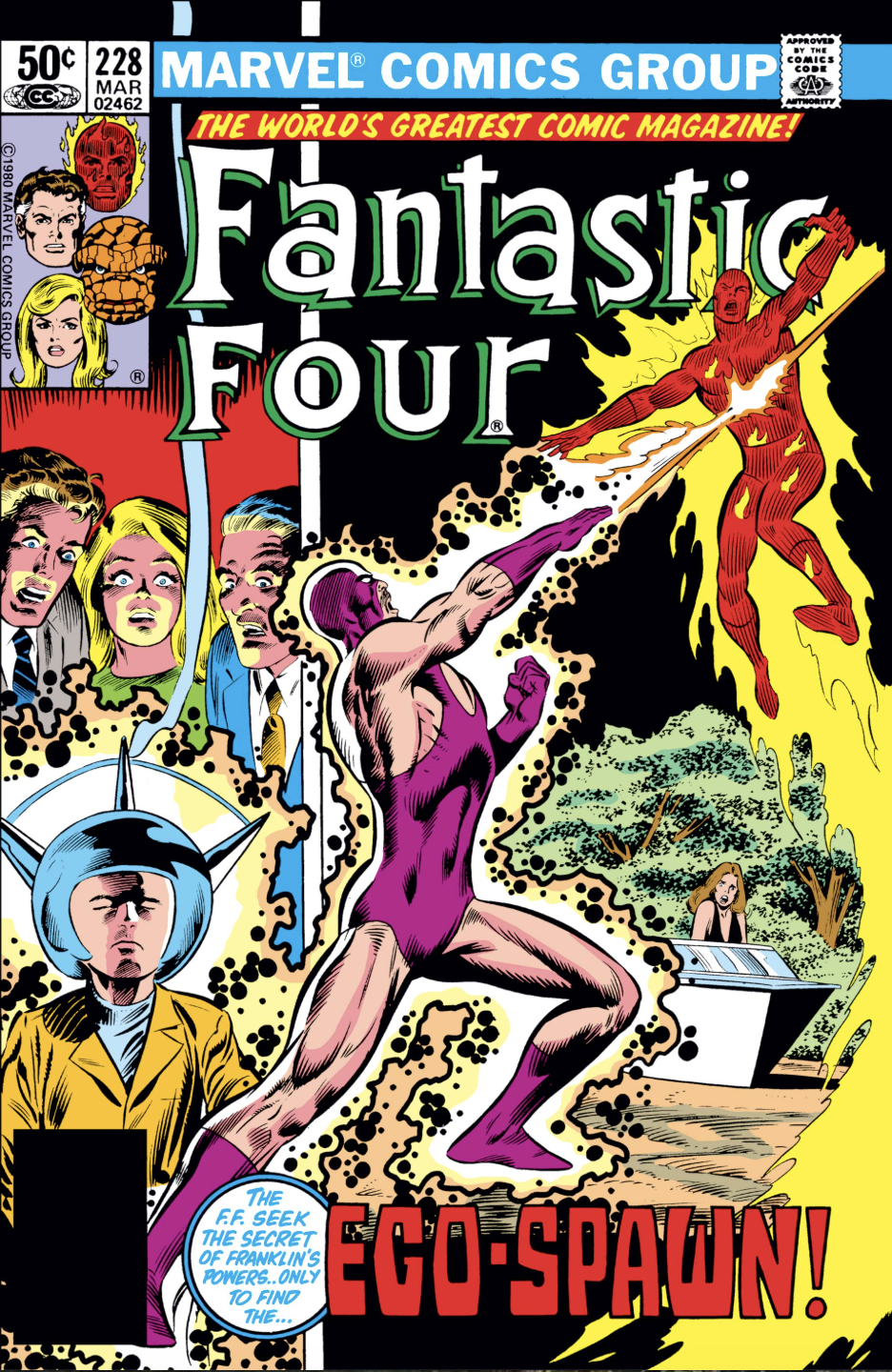
“The World’s Greatest Comic Magazine!” Fantastic Four No. 228

Tags

, , , , , , ,

Fantastic Four 228
“Ego-Spawn”
Published December 1980
Writer: Doug Moench
Pencils: Bill Sienkiewicz
Inks: Joe Sinnott
Letters: Jim Novak
Colors: George Roussos
Editor: Jim Salicrup
Cover: Sienkiewicz and Sinnott


Synopsis

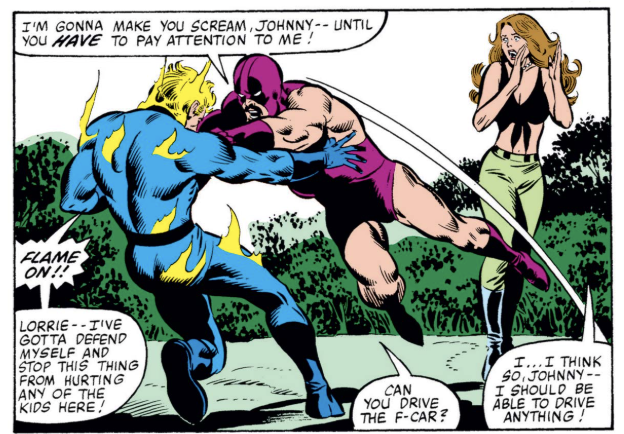
As the Human Torch prepares for a date with his new girlfriend Lorrie Melton, Mr. Fantastic and the Invisible Woman discuss how best to studying Franklin’s budding powers. With Lorrie, the team travels to Seaboard University, where Reed’s former college friend Abe Jankowitz begins testing Franklin. A biofeedback test generates a strange energy field from Franklin that travels to a nearby park where Lorrie and Johnny have decamped. The energy field transforms a local bully into a super villain who seems to embody Franklin’s darkest thoughts. After a scuffle, the FF subdue the villain and Sue unplugs the biofeedback device that triggered the reaction.


What’s going on here?

Another issue, another Doug Moench clunker. This comic begins with promise, with a lot of character development and the re-introduction of Lorrie, Johnny’s new squeeze. Reed and Sue’s commitment to investigating Franklin’s powers is also a nice narrative advancement, and builds on recent plot lines. But it all goes absurdly awry once Franklin is plugged into the biofeedback machine and somehow invents a ridiculously costumed villain. The villain is intended to embody Franklin’s anxieties, but they are never hinted at earlier in the comic (just the opposite — he is eager to be tested) and the storyline all seems so slapped together and nonsensical as to be dismissed out of hand. Further, the basic structure of the story — the FF visit an old colleague of Reed’s — seems identical to last issue.

The most interesting aspect of the story is the appearence of Lorrie, who first appeared in FF 222, and it seems Moench is positioning her to play a major role in Johnny’s life going forward (bringing a date to meet your relatives is a big step!). But as we shall see, she disappears pretty quickly and is ignored by future writers.


Joe Sinnott returned to ink this issue and it looks like he really took the reins from Bill Sienkiewicz (who in fact is only credited with layouts).


What I liked


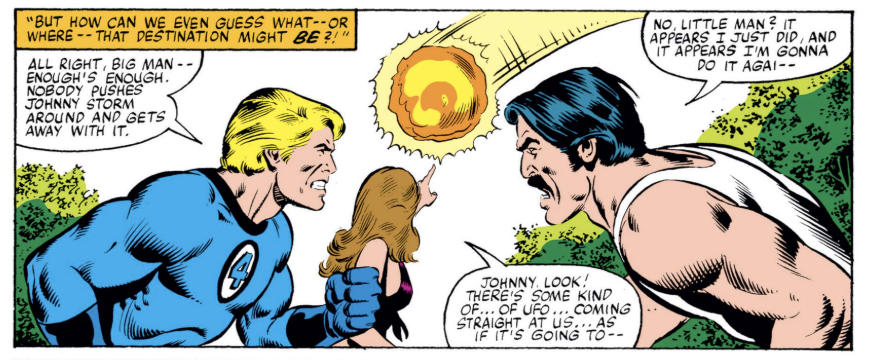
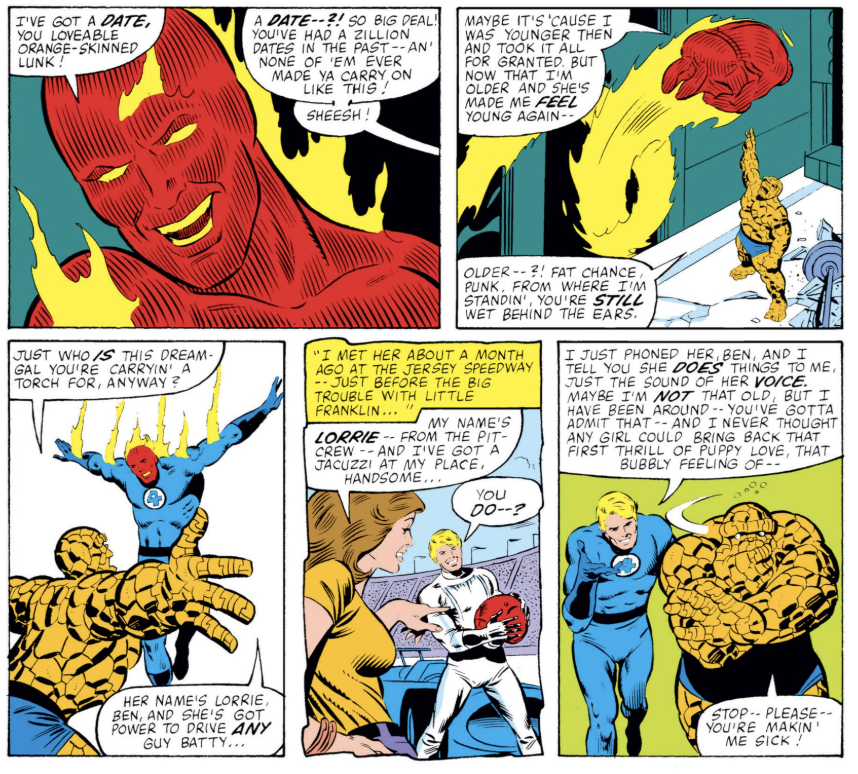
Moench does a good job with Ben and Johnny’s banter.


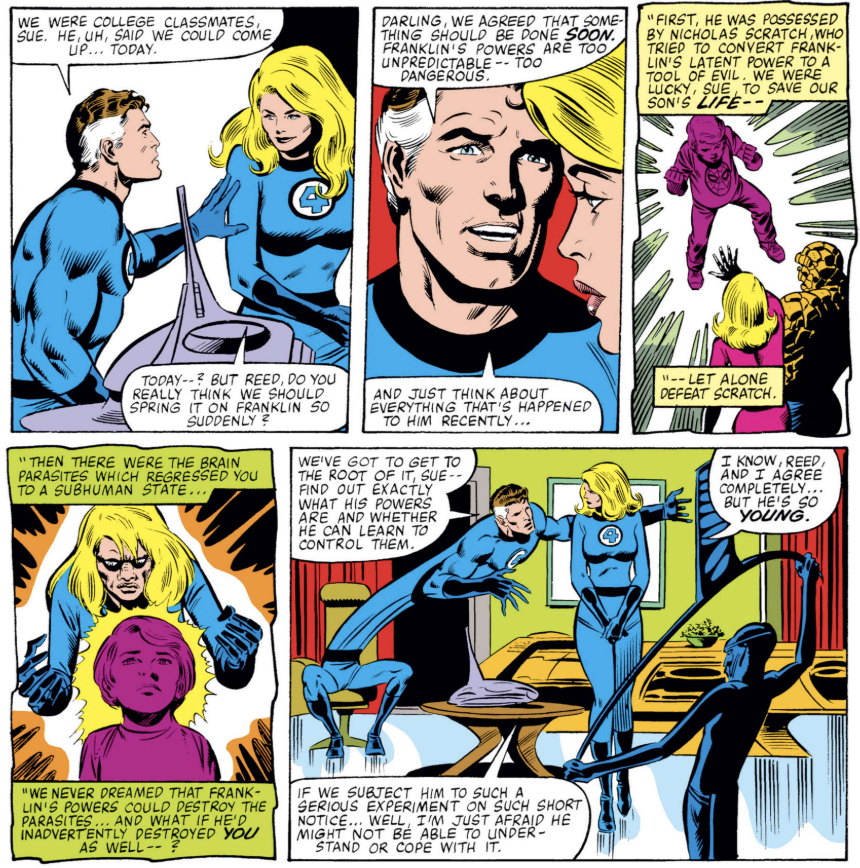
And I liked how Bill Sienkiewicz drew this interaction between Reed and Sue (including the weird sculptures in the foreground):


What I didn’t like

As discussed, the transformation of the local tough-guy into a purple-clad supervillain makes no sense, was not established by any foreshadowing and he might go down as one of the most idiotic bad guys in FF history (joining Gaard and Warhead).


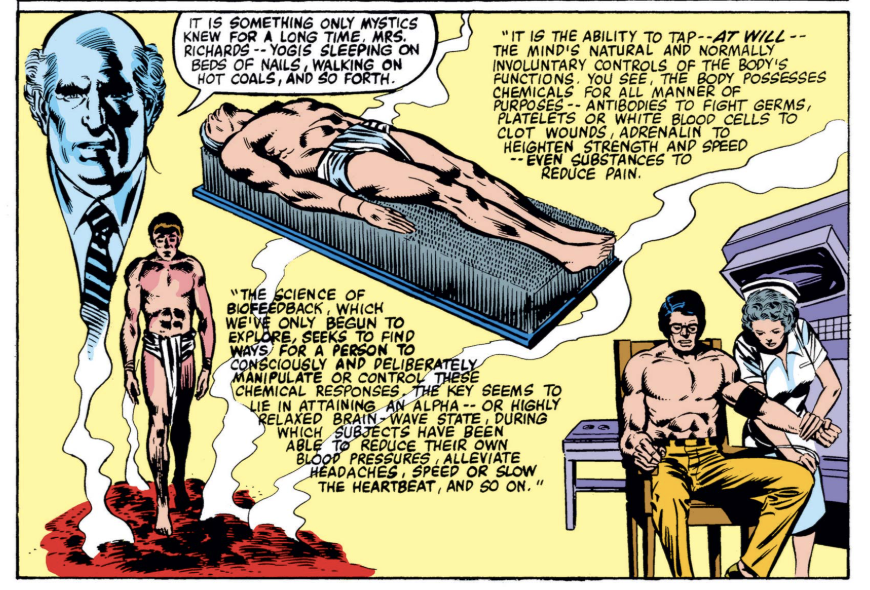
An awful lot of this comic was devoted to explaining Dr. Jankowitz’s tests. Biofeedback therapy exploded in popularity in the 1970s and I wouldn’t be surprised if Moench took part.


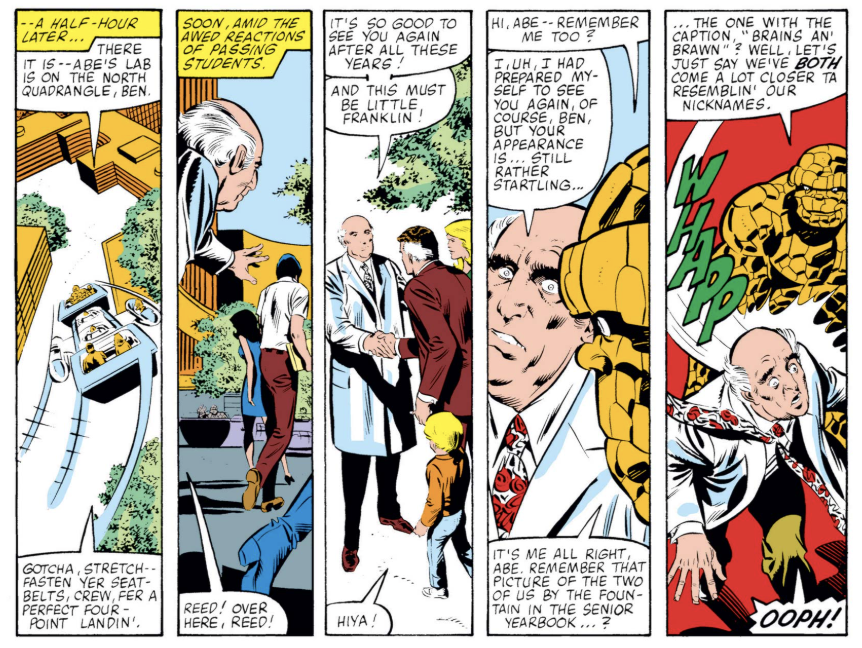
Speaking of Jankowitz, doesn’t he seem too old to have been a college classmate of Reed and Ben’s?


Anything else?

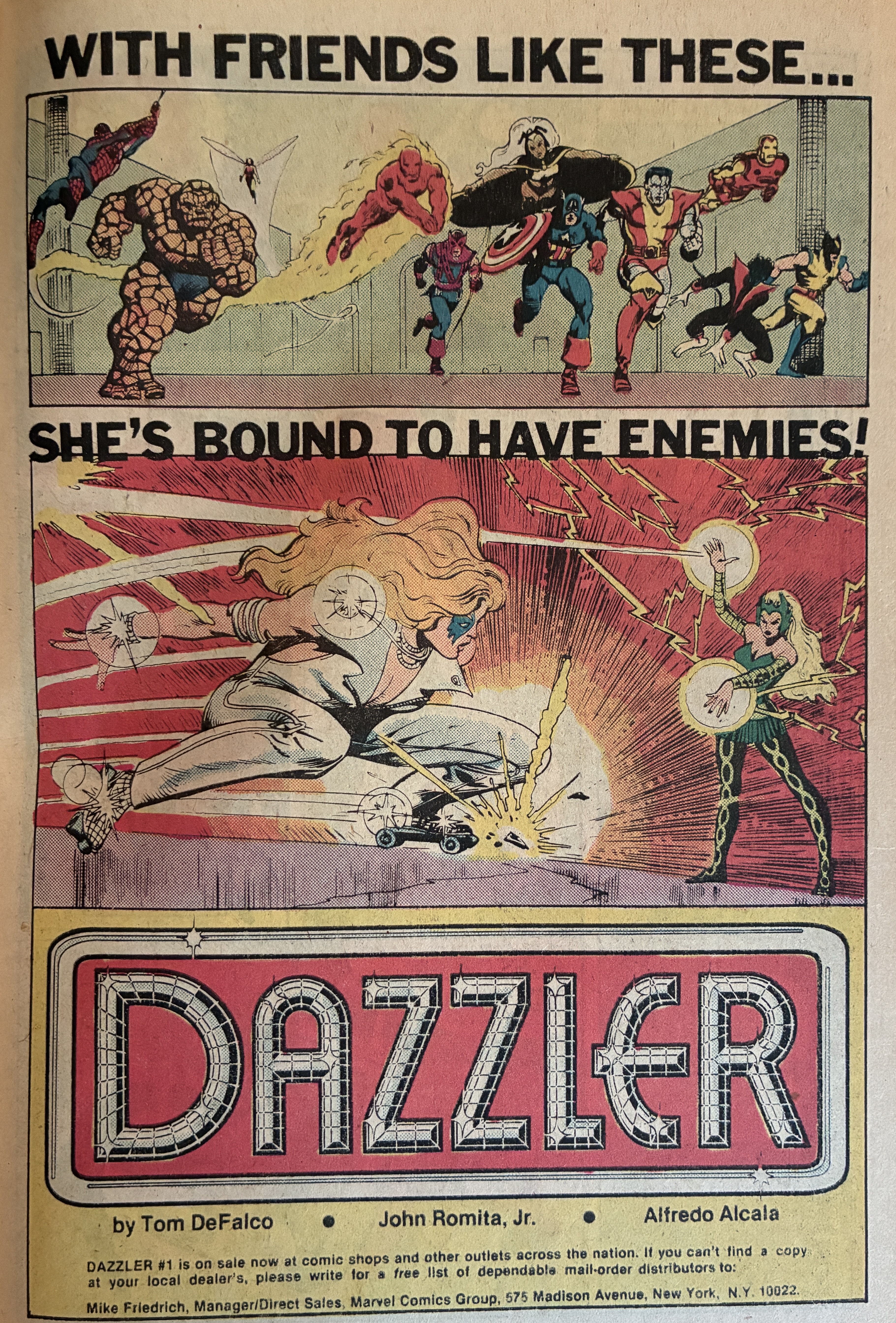
A fun house ad for Dazzler by a very young John Romita Jr.:


Overall

Dreck

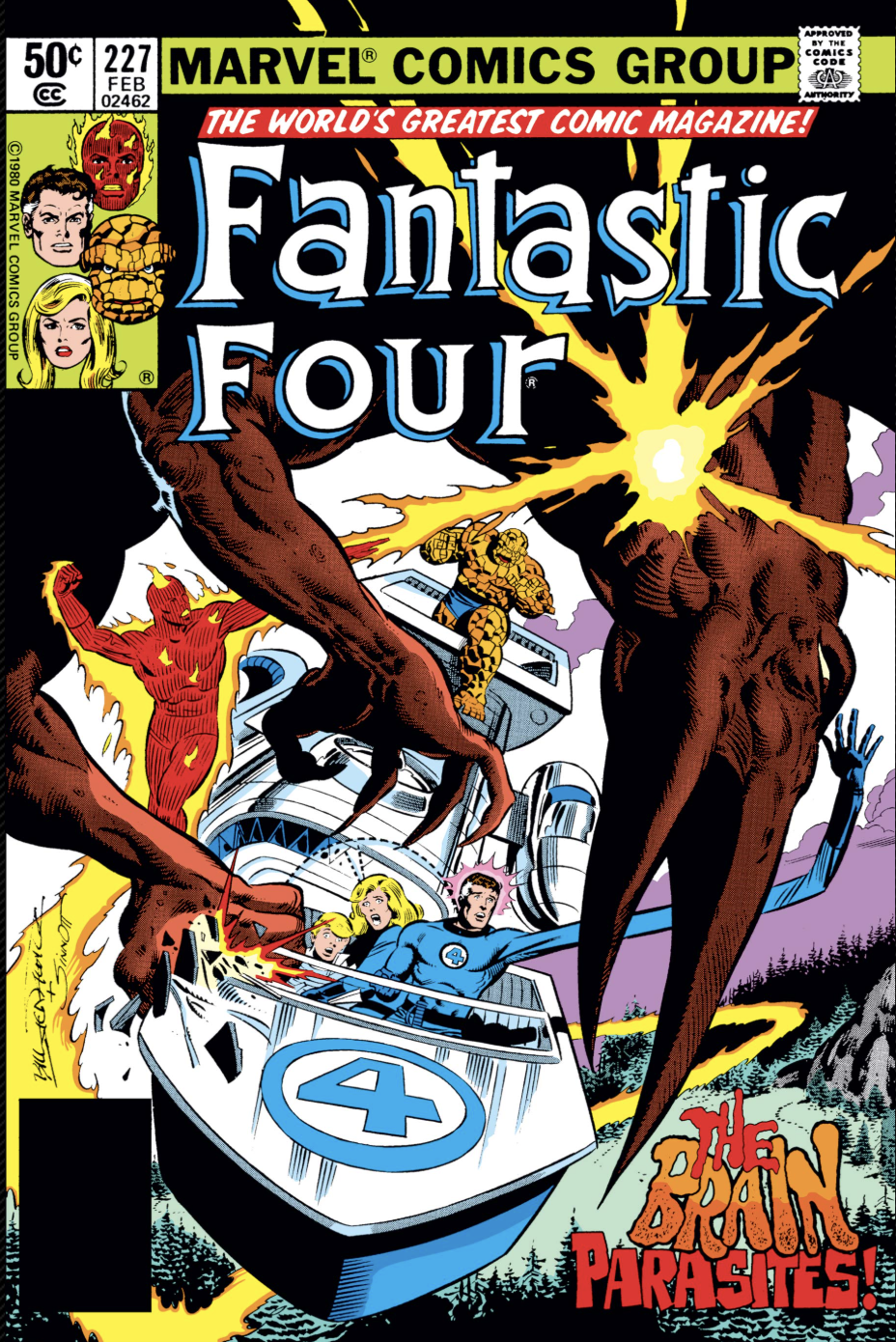
“The World’s Greatest Comic Magazine!” Fantastic Four No. 227

Tags

, , , , , , ,

Fantastic Four 227
“The Brain Parasites!”
Published November 1980
Writer: Doug Moench
Pencils: Bill Sienkiewicz
Inks: Bruce Patterson
Letters: Jim Novak
Colors: George Roussos
Editor: Jim Salicrup
Cover: Sienkiewicz and Joe Sinnott


Synopsis

An old colleague asks for Mr. Fantastic’s help investigating a meteor that landed in a Florida lake and the team plus Franklin embark on a working vacation to assist Dr. Carruthers. Once there, they discover ordinary animals are dramatically transformed into dangerous monsters by parasites that were carried by the meteor. The parasites also transform Carruthers and the Invisible Girl but are saved when the parasites are removed. It is then revealed that Franklin used his powers to destroy the monsters and parasites.


What’s going on here?

This is another old-timey science fiction story from Doug Moench that has echoes of Invasion of the Body Snatchers and Robert Heinlein’s The Puppet Masters. Moench used the mysterious-meteor-with-strange-effects just a few issues ago — it’s how Korgon the giant Viking got his powers — and the FF-encounter-strange-underwater-monsters-on-a-Florida-vacation plot was previously used by Stan and Jack in FF 97.

We’re now seven issues into the Moench run and it seems pretty clear he’s most comfortable with a certain type of story that hews closely to traditional horror and sci-fi tropes. There is a place for those stories, and they can be done quite effectively in the Fantastic Four as we shall see, but telling only those stories wastes the potential of the FF. The Fantastic Four is at its best with big, sweeping epics where the villains are truly menacing and the stakes are high. I had lots of quibbles with Marv Wolfman’s run but he at least understood the importance of big stories. (This is also my main critique of the FF’s current writer, Ryan North, who prefers to deliver monthly science lessons rather than invest in multi-issue arcs.) There are four more issues of Moench; hopefully things pick up.

Joe Sinnott is again MIA (although he did ink the cover), with Bruce Patterson handling the inking. Patterson seems like a jack-of-all-comic-trades — with credits as inker, letterer and colorist — and worked steadily for both Marvel and DC from the mid 70s to the late 90s. His inks are heavy and brooding in this comic, and he gives on Reed and Johnny hollow cheeks that make them look haggard and gaunt.


What I liked

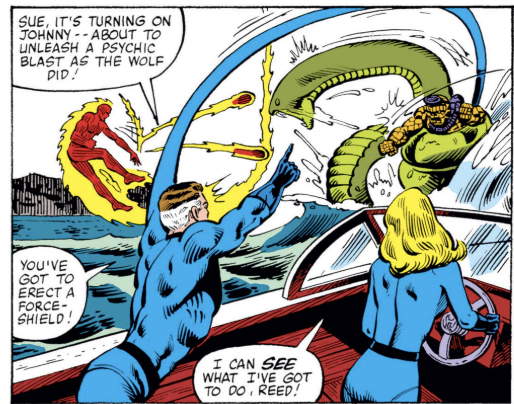
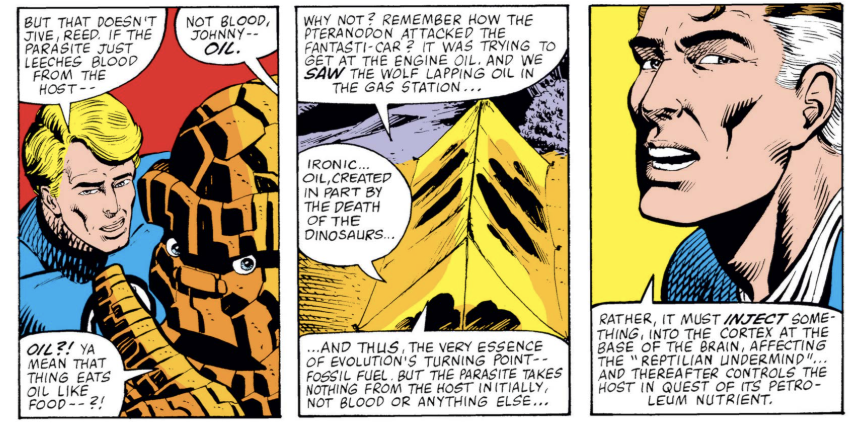
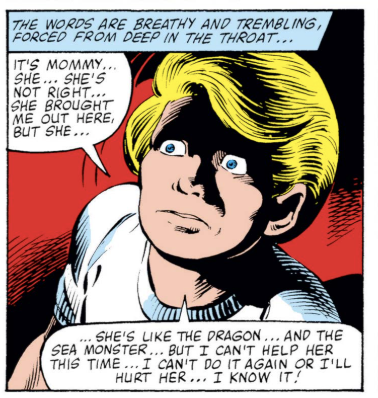
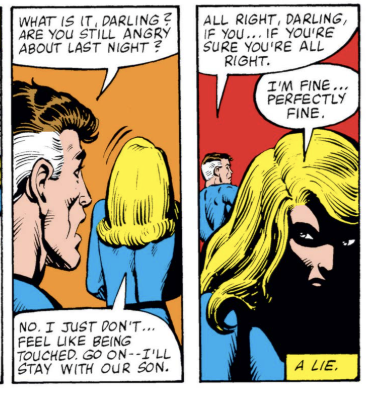
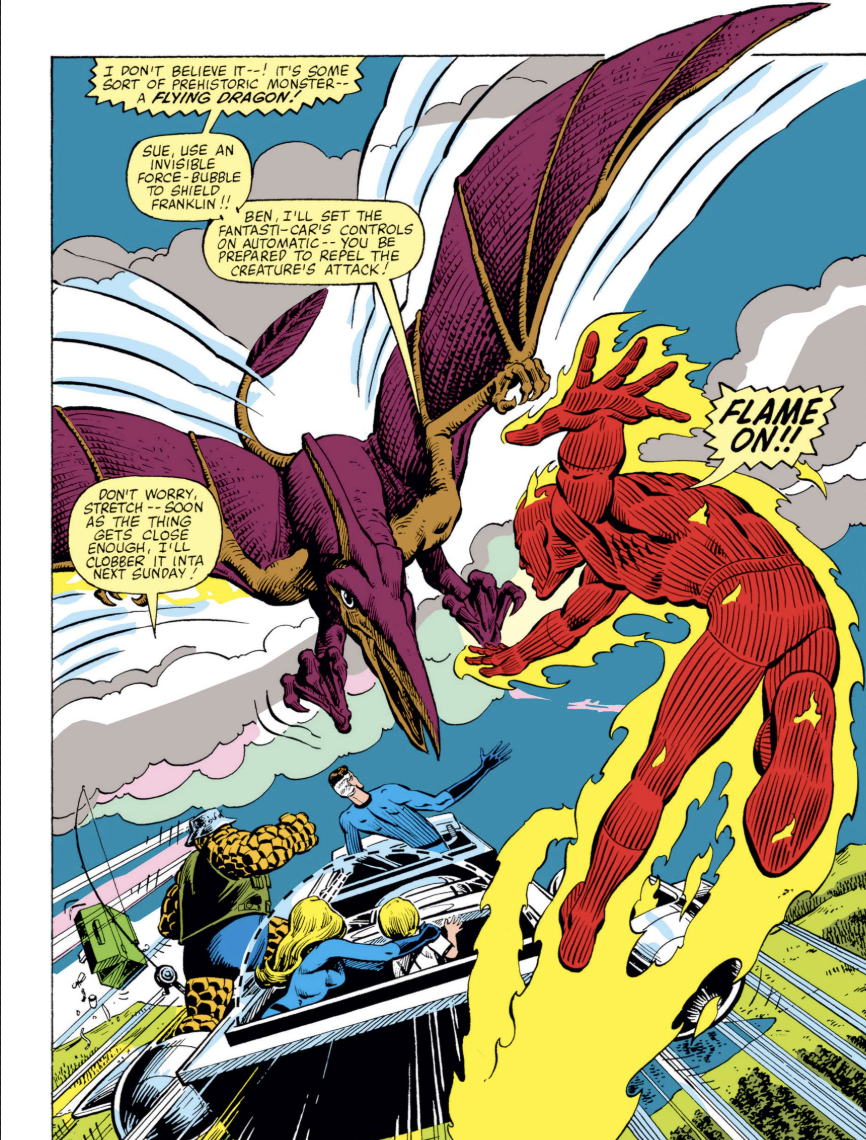
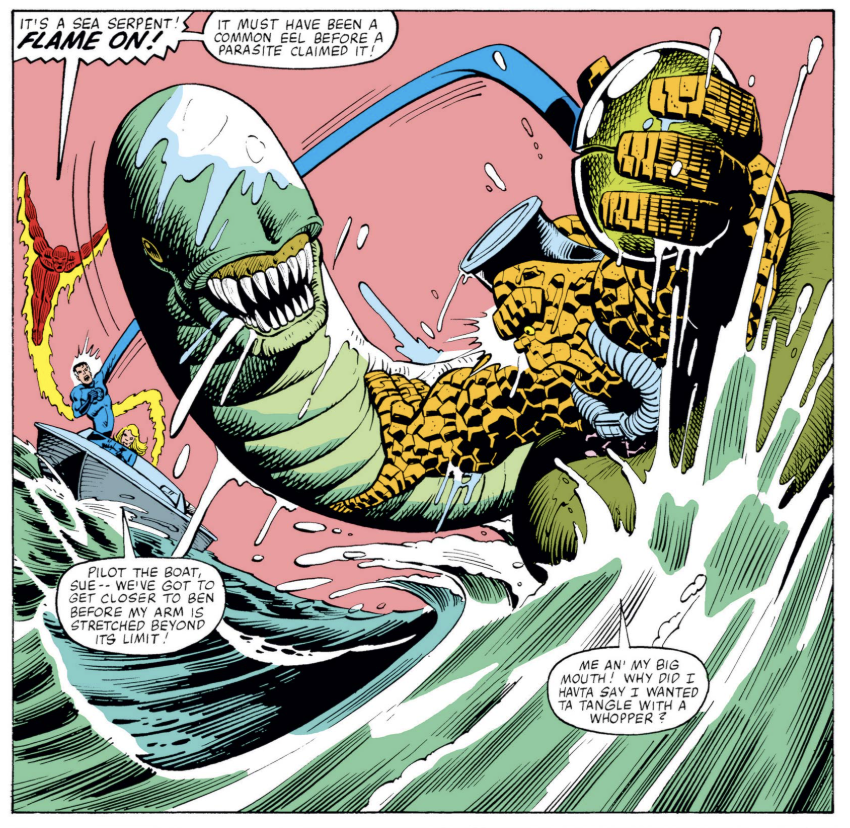
There were some fun action sequences, and Bill Sienkiewicz seems to have a blast with the monsters that attack the FF. As in this splash:


Or here:


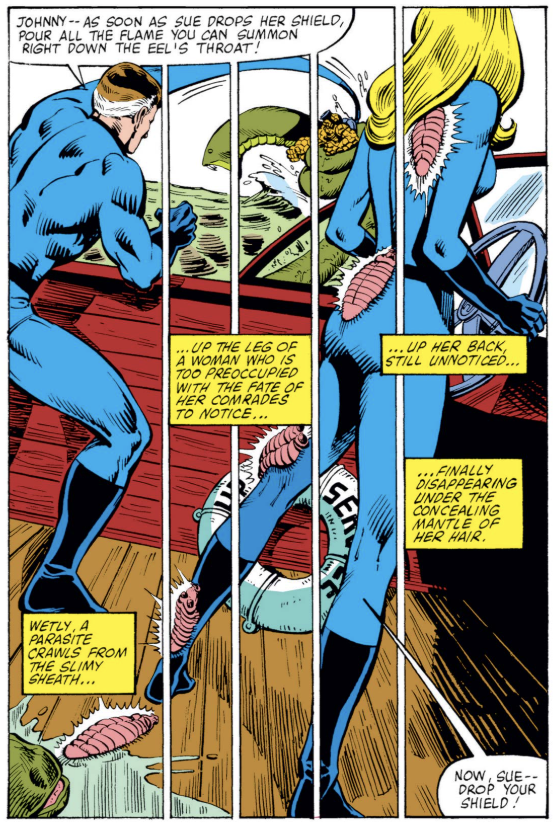
I’m not sure this time-lapse sequence of the parasite crawling up Sue is totally successful — initially I thought she was covered in multiple parasites — but it looks cool.


What I didn’t like

The “spontaneous vacation” idea is pretty tired by now. I guess Moench thought he needed a good reason to get Franklin on the trip, but it feels forced.

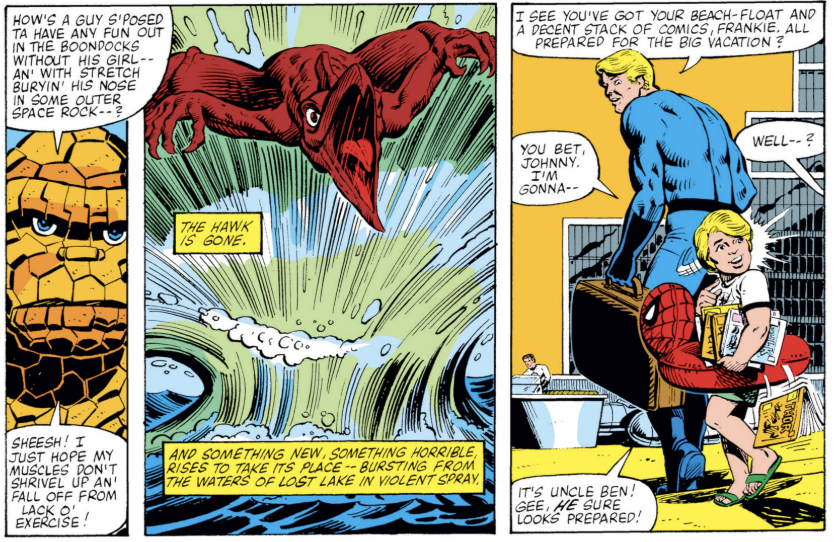
Also, these recent issues have sequences of panels that jump from scene to scene without any explanation. Like here:

It’s not hard to follow the story, but I’m not sure what is accomplished by the cutting back and forth, either. I do like Franklin’s Spider-Man pool float.

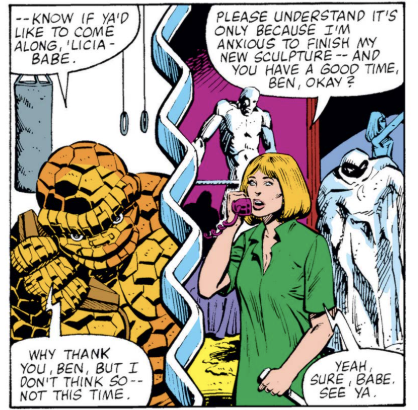
Wait, did Moench finds a way to drop in a cameo of a character from one of his other books? Who could have seen that coming?


Anything else?

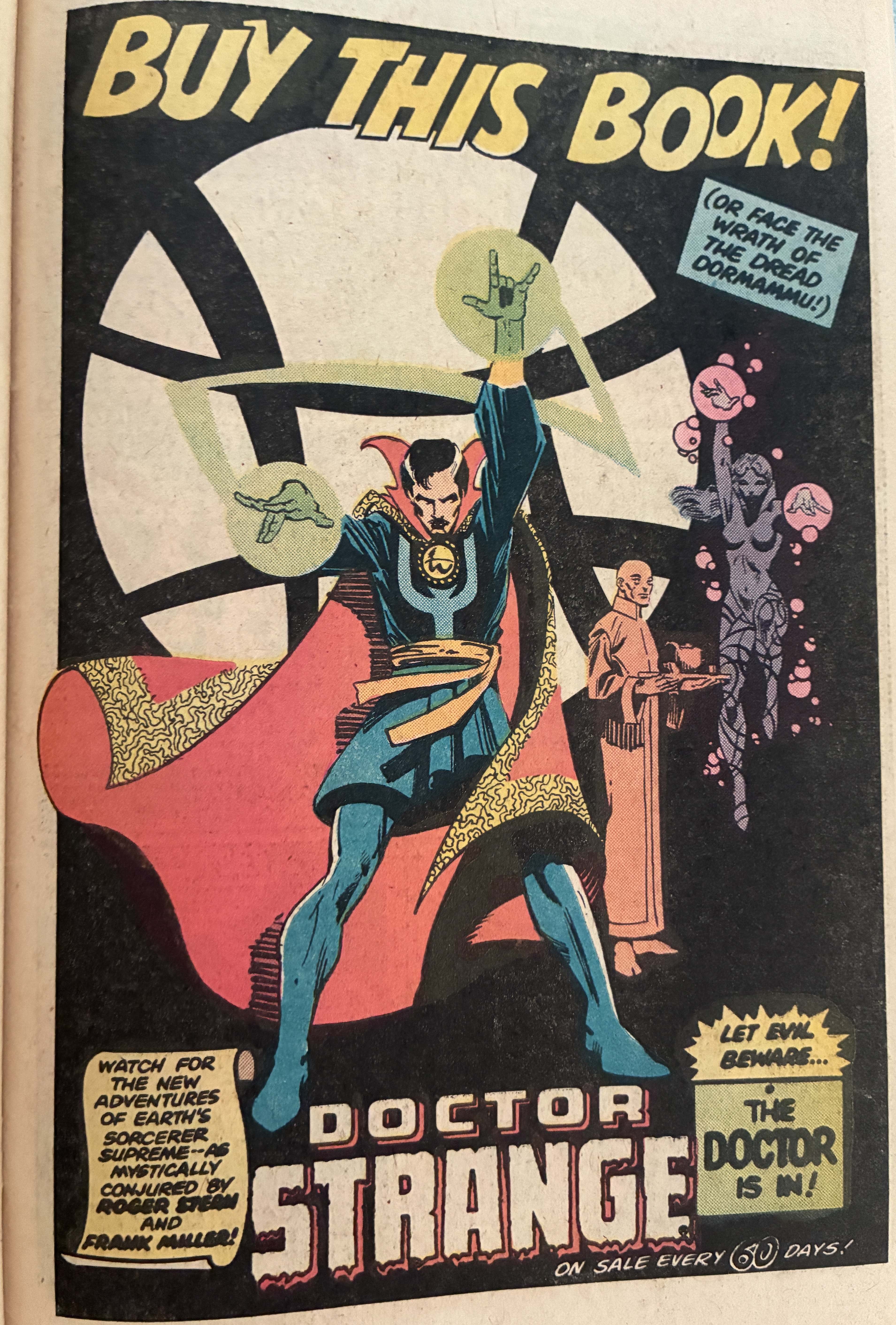
This is a cool house ad for a Roger Stern / Frank Miller Dr. Strange collaboration that never happened. You can read why here.


Overall

A heaping dose of meh.

“The World’s Greatest Comic Magazine!” Fantastic Four No. 226

Tags

, , , , , , ,

Fantastic Four 226
“The Samurai Destroyer”
Published October 1980
Writer: Doug Moench
Pencils: Bill Sienkiewicz
Inks: Pablo Marcos and Bruce Patterson
Letters: Jim Novak
Colors: George Roussos
Editor: Jim Salicrup
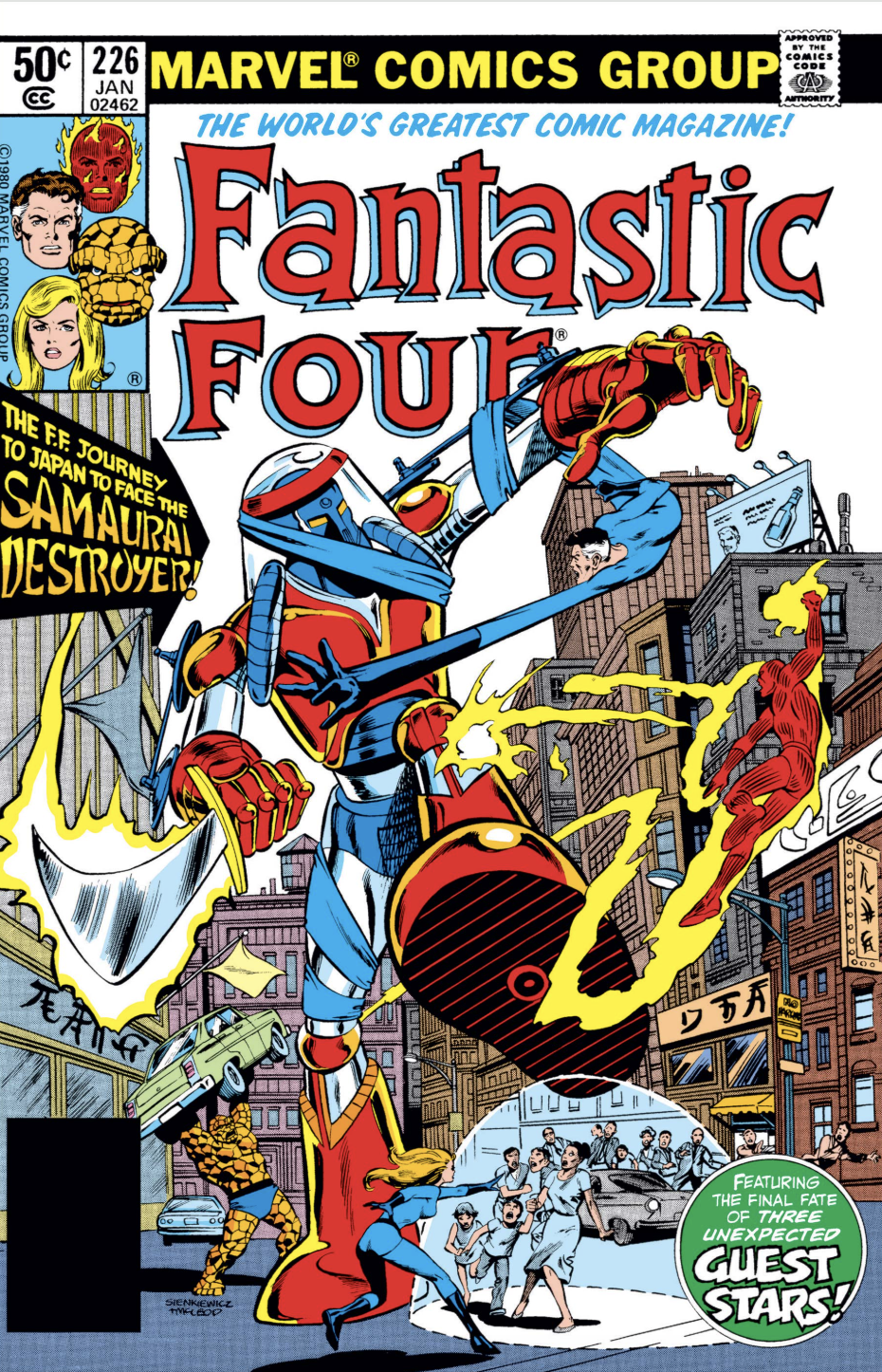
Cover: Sienkiewicz and Bob McLeod


Synopsis

The Fantastic Four learn about a giant robot stealing a train carrying gold on the television news, then are met at the Baxter Building by the three former pilots of the Shogun Warrior robots, now destroyed. The FF and three pilots travel to Japan, where the new giant robot, the Samurai Destroyer, is robbing a bank. While the FF attempt (and fail) to stop it, the pilots travel to the sanctuary where the Shogun Warriors were built. There, they are confronted by the Samurai Destroyer and its pilot who explains he destroyed their robots. The FF catch up with him and eventually defeat him, but not before he self-destructs the Samurai Destroyer.

What’s going on here?

A guest appearance in a Doug Moench-written comic? What are the odds they feature in another Moench-written book? If you guessed 100%, you’d be right. For the third story in a row, Moench has slipped in characters from a former, current or future comic he’s writing (following Moon Knight and Thor). This time, of course, the Shogun Warriors make more than a token appearance, but are central to the whole dismal comic.

The Shogun Warriors were a toy tie-in that had their own comic for 20 issues, all but one written by Moench. I confess I’ve never read them, but they look pretty forgettable. Apparently while Moench was able to wrap up their story (in an issue guest starring the FF, or course), he or someone at Marvel decided they needed to tie up the loose end of three enormous robots that could be commandeered by a villain. Hence this issue, in which the robots are destroyed.

While I sort of respect the desire to address the big robot problem, I wish it hadn’t been at the expense of a decent Fantastic Four comic. This story is forced and clunky, with a cheesy lesson in parenting for Reed and way too much energy devoted to the fates of three characters most readers had never heard of. This is probably Moench’s worst issue, and Bill Sienkiewicz, aside from a few bright spots, doesn’t do much to salvage this dreck.

A few side notes: Joe Sinnott is again MIA, with Pablo Marcos and Bruce Patterson inking. And the cover is inked by Bob McLeod, making his FF debut.


What I liked

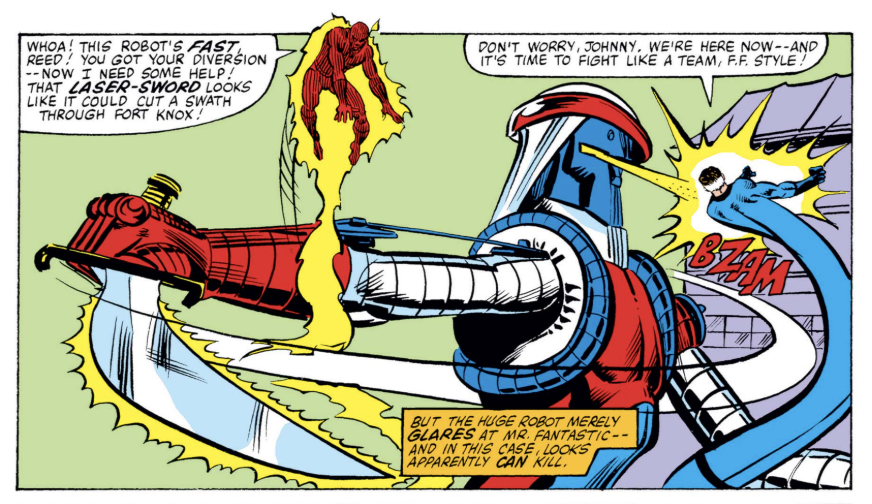
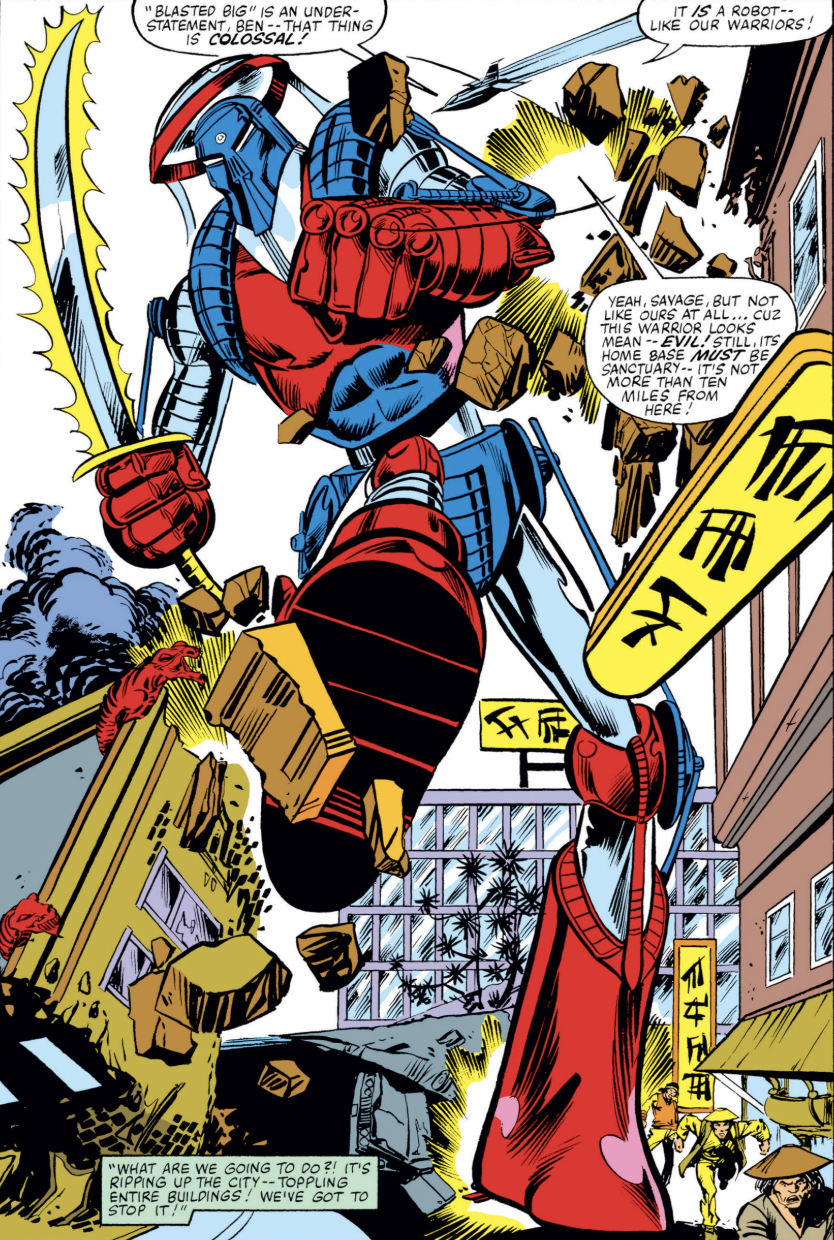
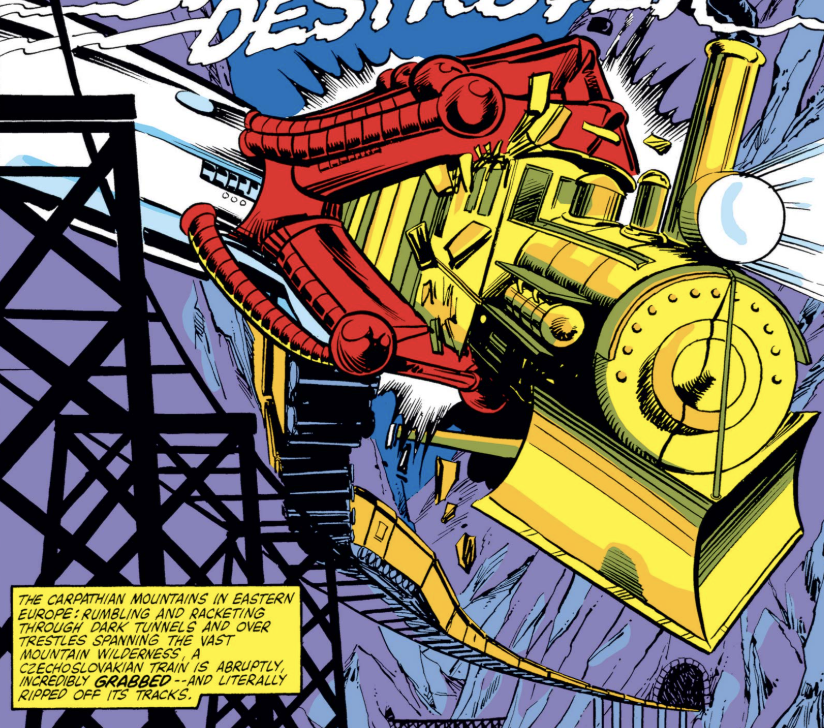
It’s hard to go wrong with a giant robot splash page:


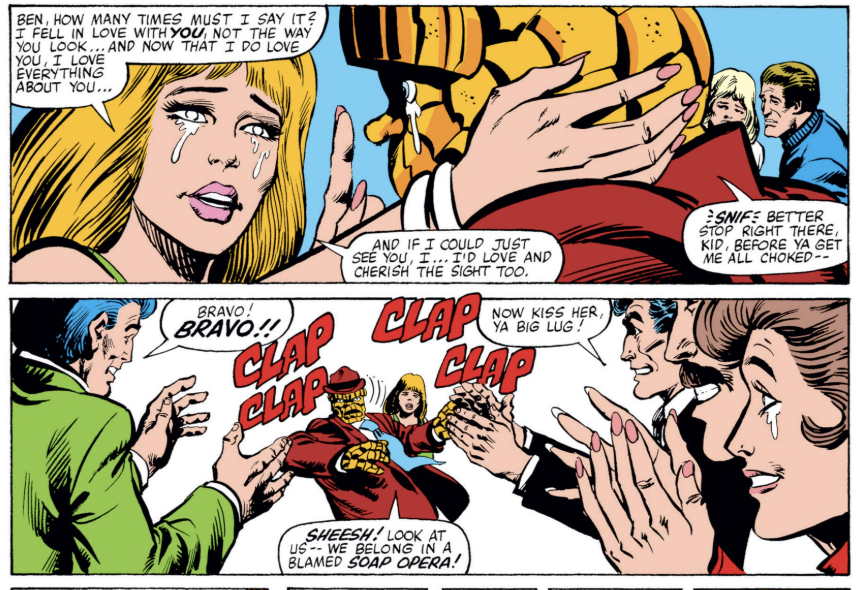
I liked this fun scene with Ben and Alicia:


What I didn’t like

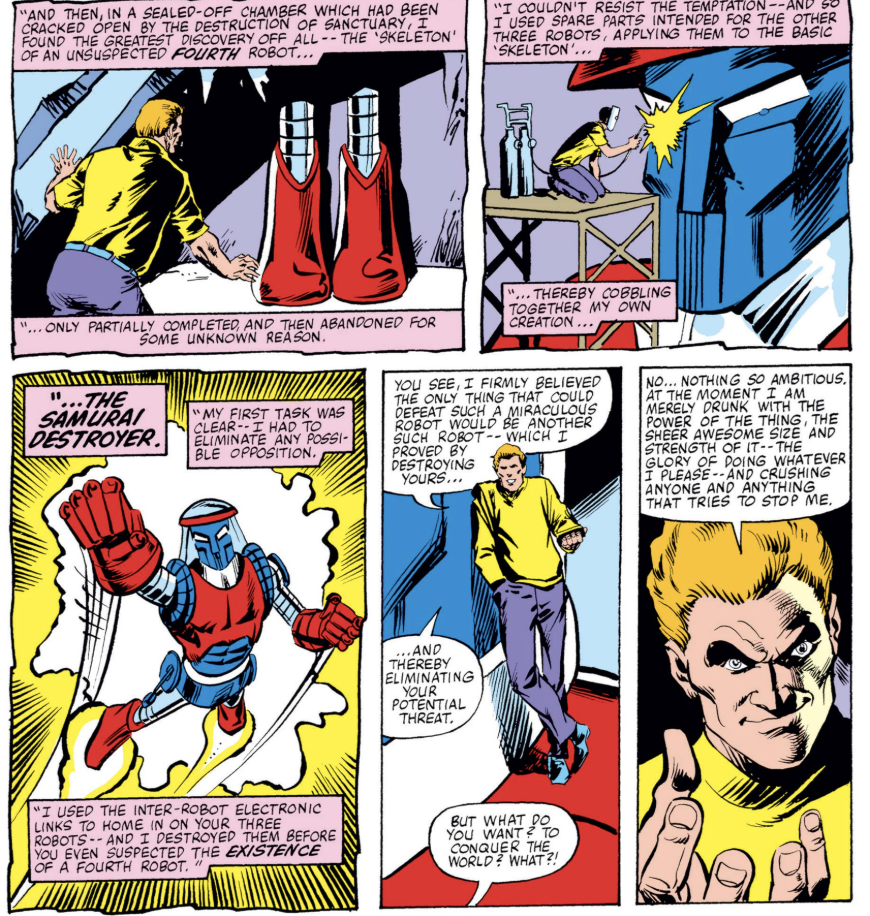
As ever, Moench is the master of unnecessary exposition. In this case, the villains’s origin is so lame he shouldn’t have bothered with a back story.


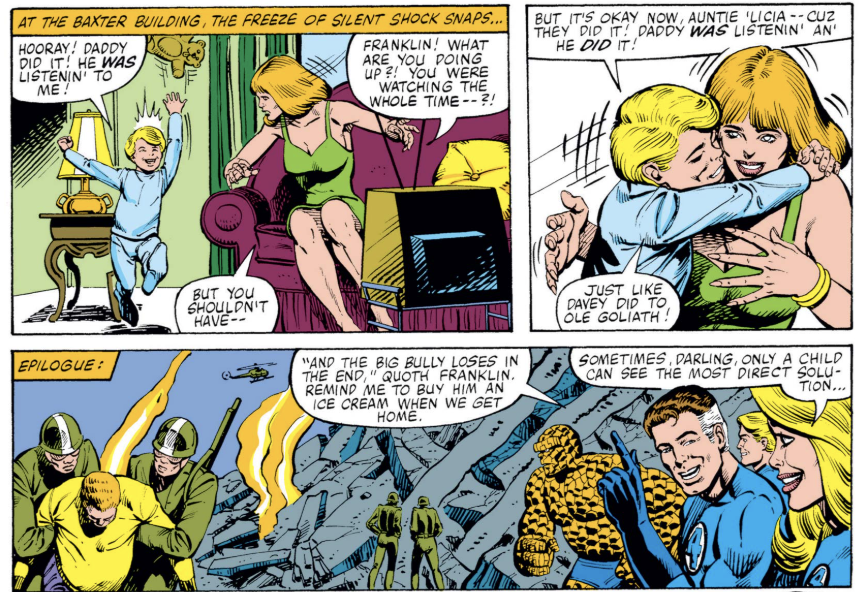
So early in the comic Reed patronizes Franklin, then later uses his story of David and Goliath to defeat the Samurai Destroyer, redeeming him in his son’s eyes. It’s as lame as it sounds.


Were they really still using steam trains in Czechoslovakia in 1980?


Overall

The less said about this, the better

“The World’s Greatest Comic Magazine!” Fantastic Four No. 225

Tags

, , , , , , , ,

Fantastic Four 225
“The Blind God’s Tears”
Published September 1980
Writer: Doug Moench
Pencils: Bill Sienkiewicz
Inks: Pablo Marcos
Letters: Jim Novak
Inks: George Roussos
Editor: Jim Salicrup
Cover: Sienkiewicz and Joe Sinnott

Synopsis

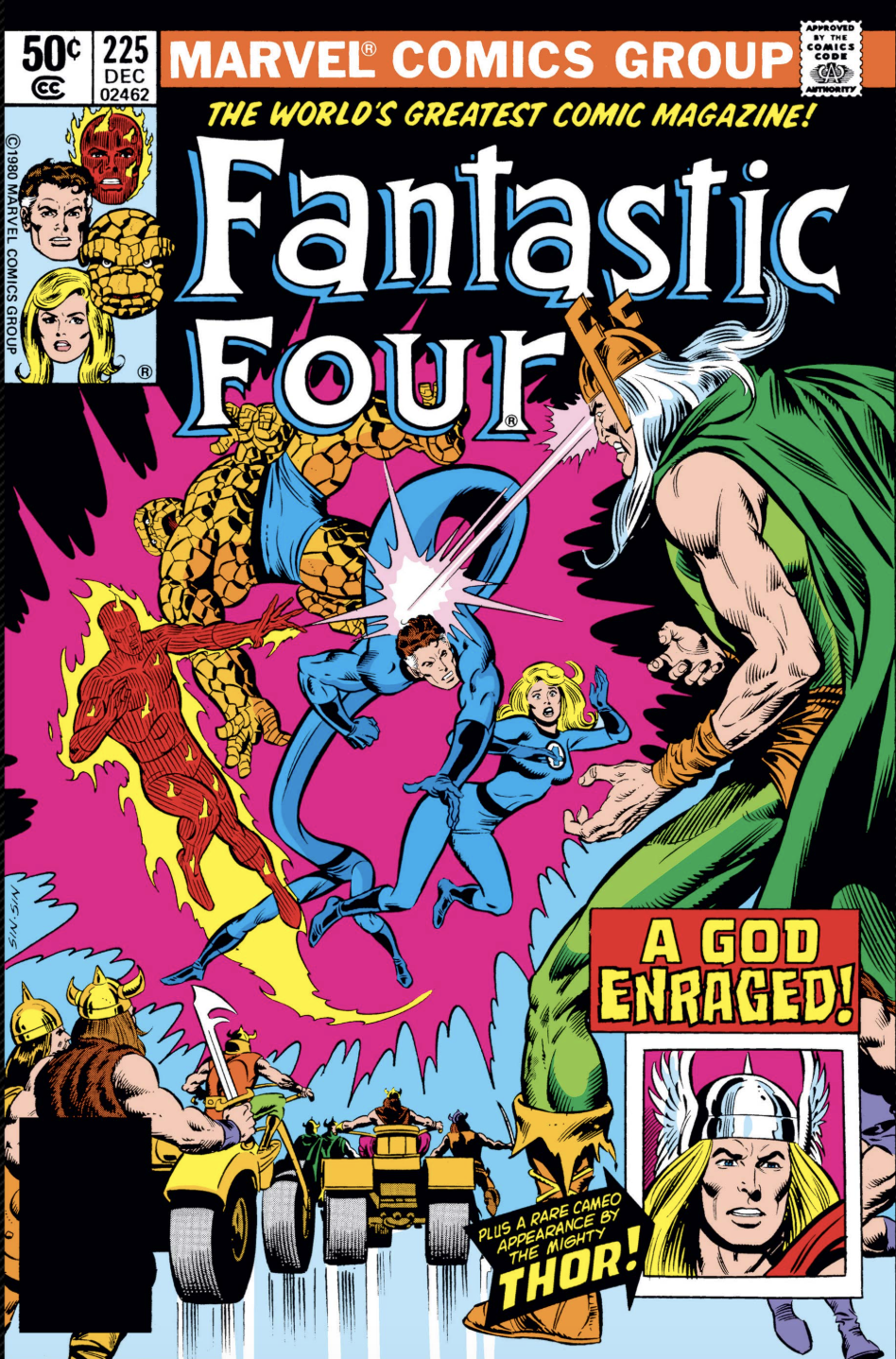
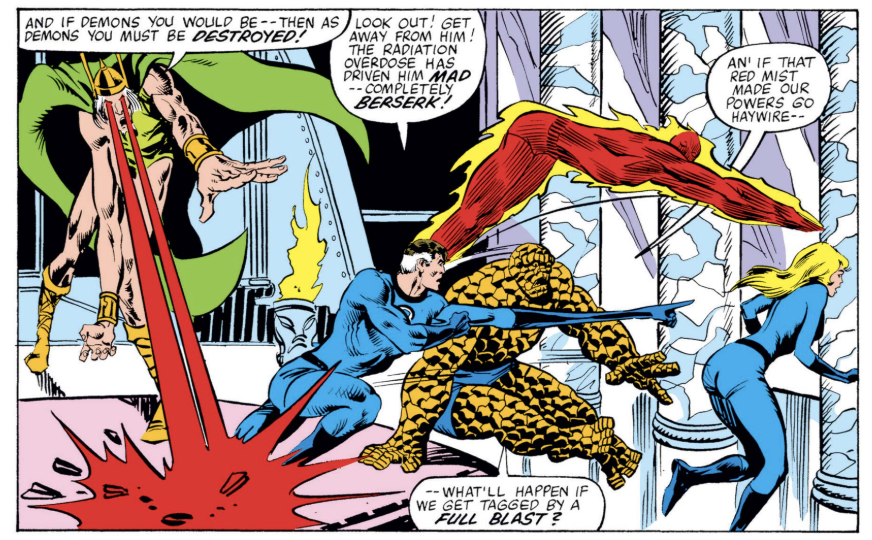
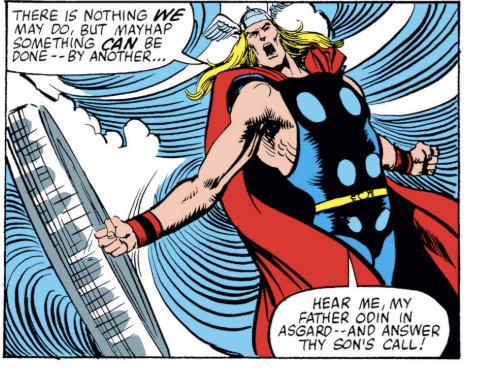
Under the threat of death, the Fantastic Four labor to restore the powers of Korgon, the Norseman who was granted immortality and strange powers by a meteor millennia ago. They succeed, and after Korgon uses his power to recharge the battery of his civilization’s ice dome, he asks Mr. Fantastic to restore his humanity. To prevent this, one of Korgon’s henchmen sabotages the machine, flooding Korgon with power. He attacks the FF, who are joined in battle by Thor, dispatched by Odin who seems to be keeping an eye on these former Vikings. Driven mad, Korgon begins destroying the ice dome. Odin then appears and restores Korgon’s sanity, and a humbled Korgon allows the FF to depart.


What’s going on here?


This is another clunky issue, with lots of exposition, a not-terribly-well explained appearance from Thor and Odin and a lackluster ending. There’s a throw-everything-against-the-wall quality to this story, with its lions and tigers in the arctic and Vikings with motorcycles, that leads to clumsy explanations that do little to further the story. The appearance of Thor makes more sense when you realize Doug Moench began writing Thor the next month, and as with last issue’s reference to Moon Knight, he apparently is happy to cross promote his books to goose their sales. FWIW, the appearance of Odin appearing to make everything better occurs again in FF 262 during the Trial of Reed Richards, although it’s handled much more adroitly by John Byrne.
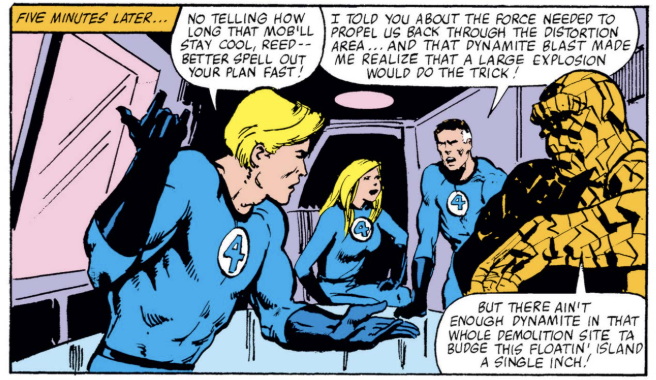
Pablo Marcos handles the inks again, although Joe Sinnott inked Sienkiewicz’s cover.

One oddity: Despite Korgon and his enclave surviving, this is apparently their first and only appearance. Given Marvel’s propensity for mining its back catalog for characters and concepts, their disappearance might say something about how future writers viewed this particular story.
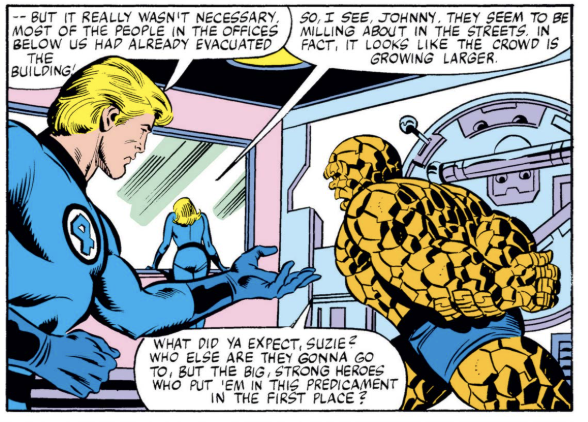
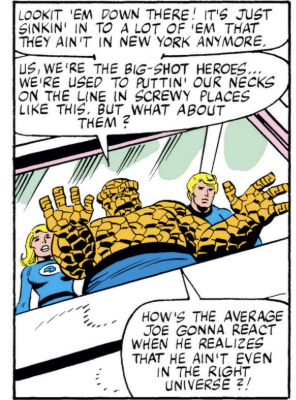

What I Liked

Bill Sienkiewicz’s pencils are again uneven, but he does hit some high notes. This long vertical panel of Korgon going nuts is great:


So is this panel of Thor


This may not be the best drawn panel but I enjoyed watching the FF cut loose a bit:


And I appreciated a few panels of Alicia and Franklin. On too many of the FF’s adventures that are completely absent.


What I didn’t like

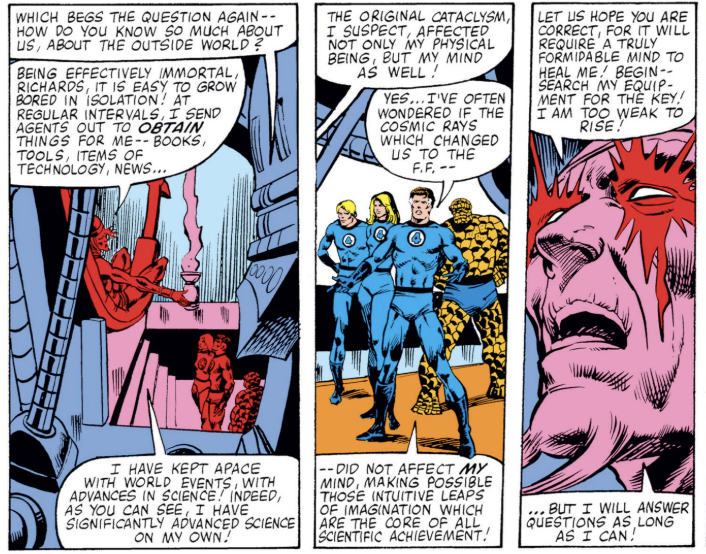
If you read the middle panel, you’ll see Reed is attributing his mental agility to the cosmic radiation that gave him his powers. This has been raised a few times in more recent years, but it seems like a pretty big revelation to drop in the middle of an unrelated story.


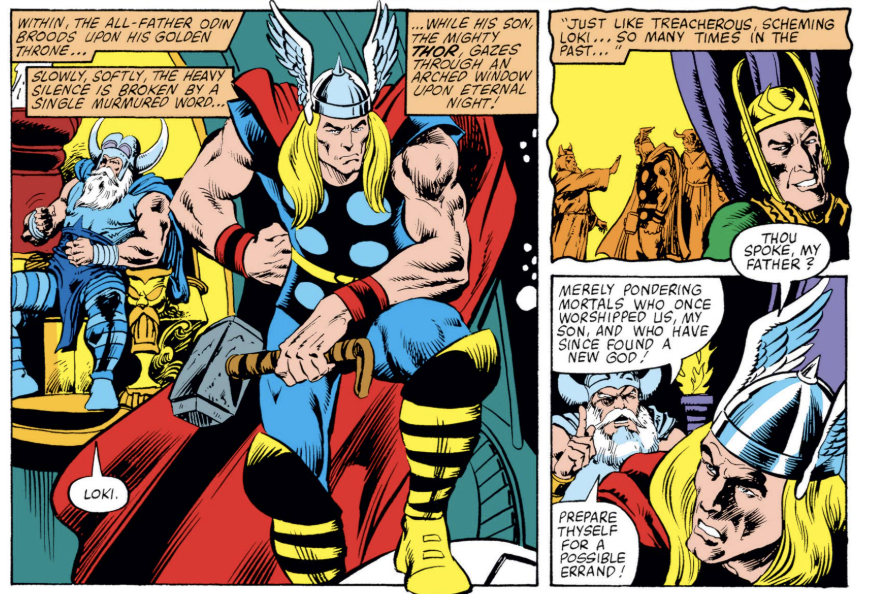
As mentioned, the appearance of Thor and Odin feels forced and is a bit of literal deus ex machina. It doesn’t help that Odin mentions Loki, suggesting he has something to do with the story (he doesn’t)


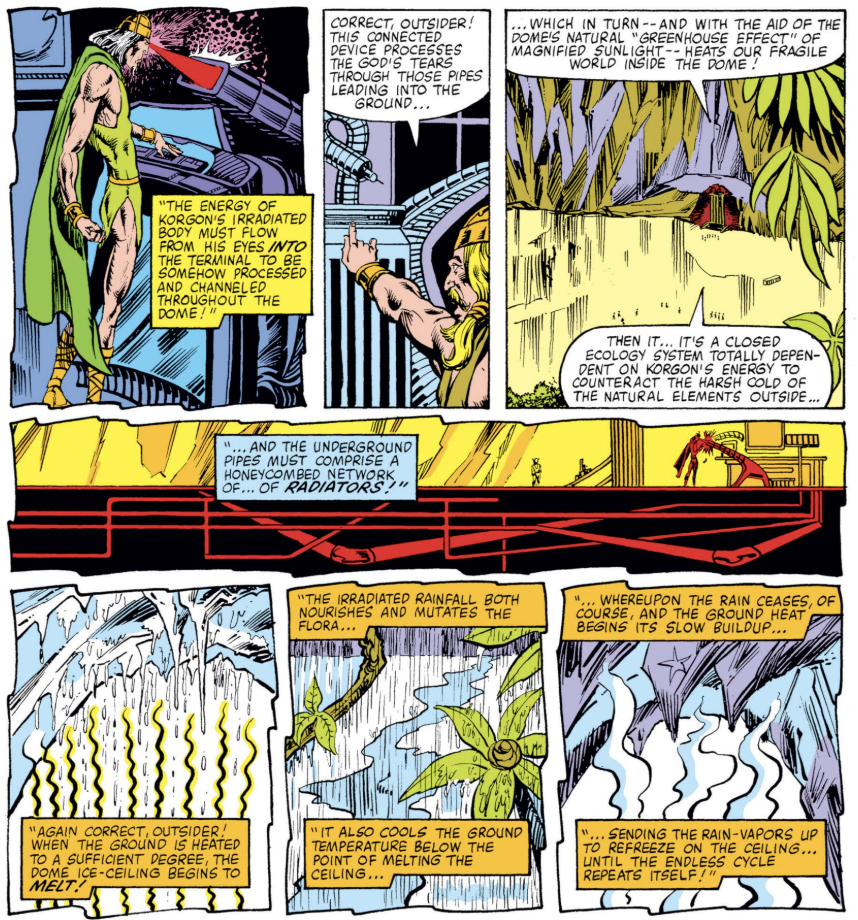
Also as mentioned, there are pages of exposition in this comic that feel totally unnecessary. I really did not need to know the secret of the Vikings’ irrigation system.


Anything else?

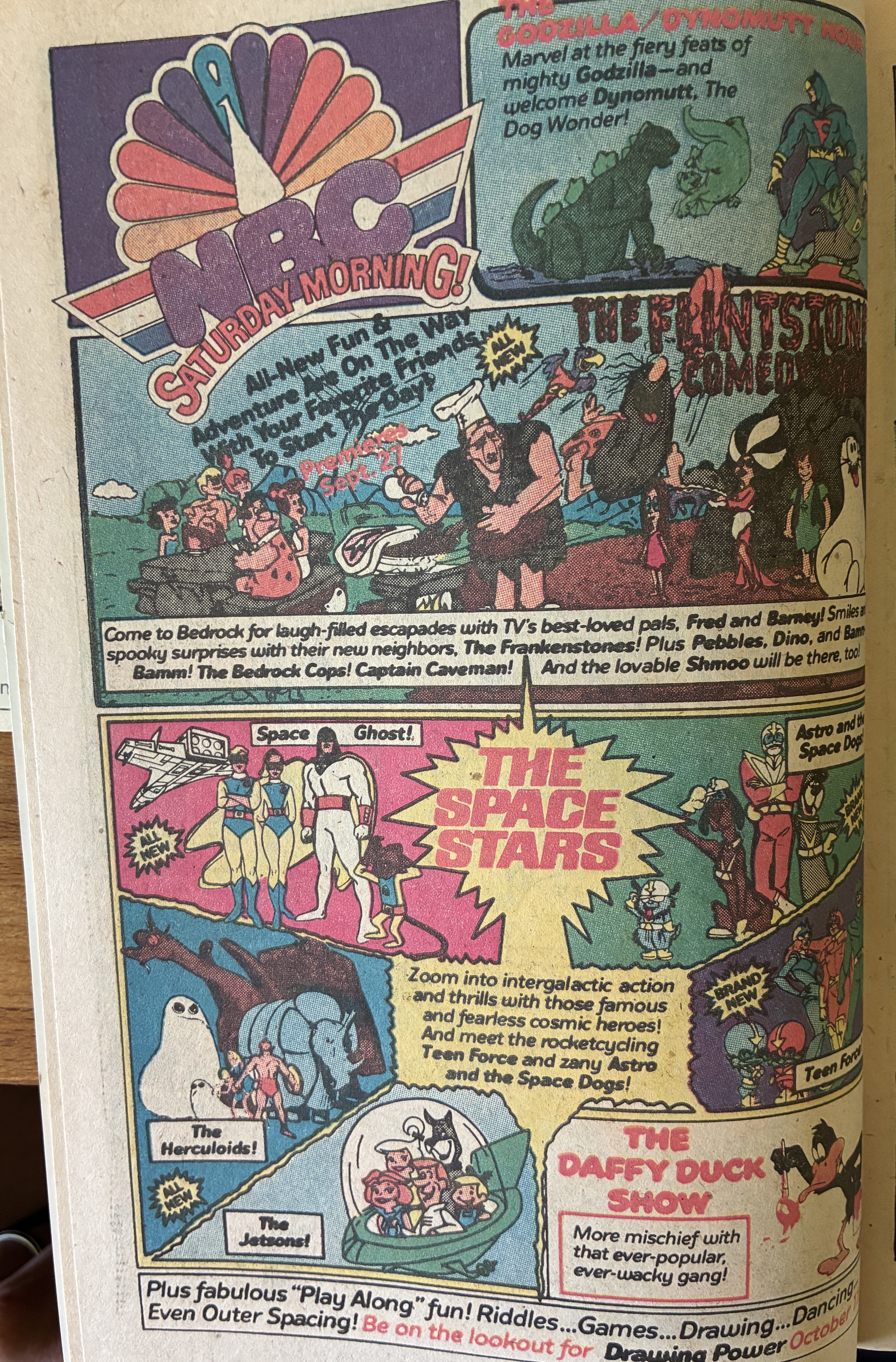
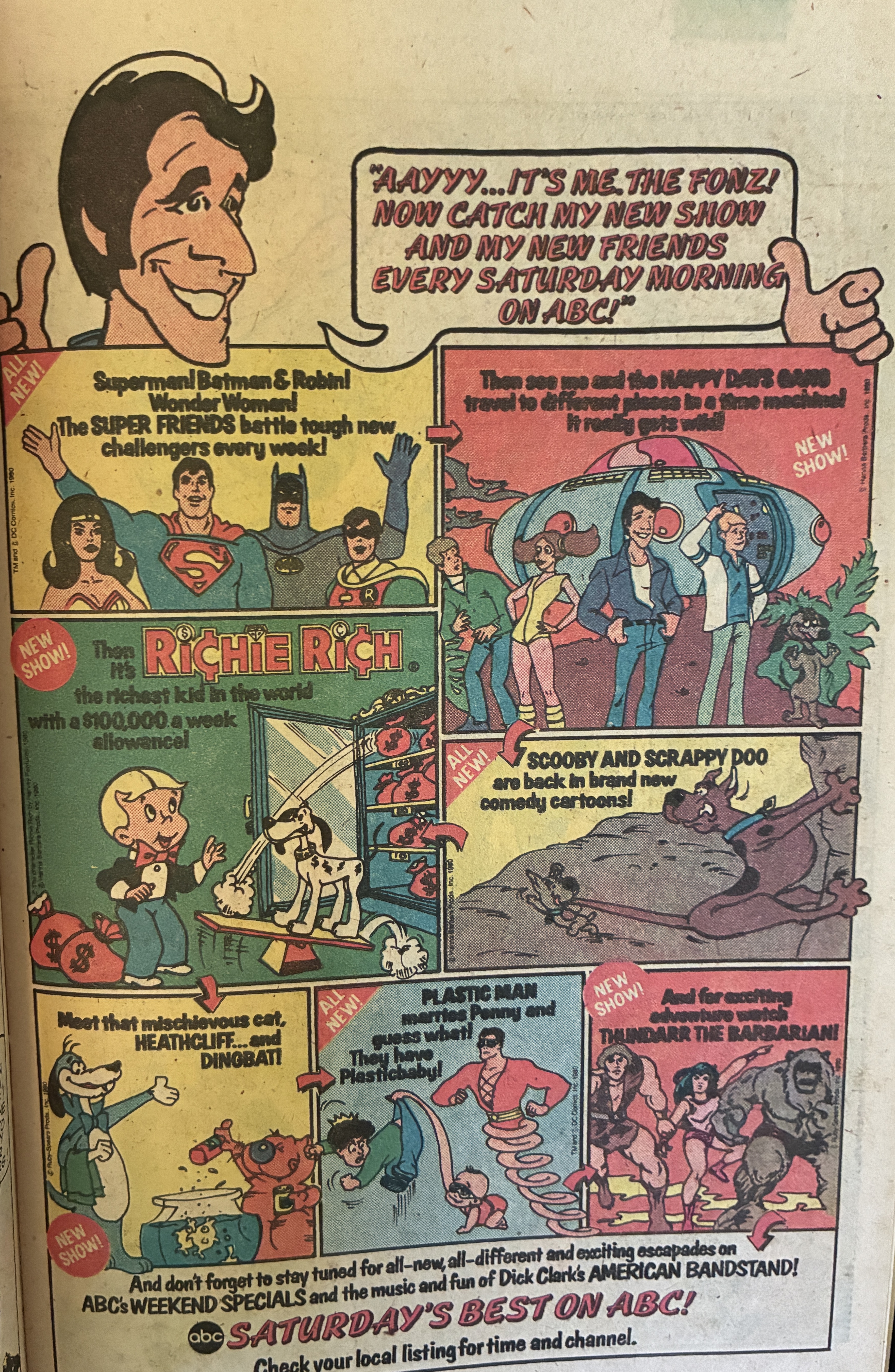
It’s that time of year again when the TV networks announce their Saturday morning schedules. Here are ads for NBC and ABC’s (CBS’s ran last month). Of note is Thundarr the Barbarian, a show created by Steve Gerber with character designs by comics legends Alex Toth and Jack Kirby, and the Herculoids, a personal favorite designed by Toth. Also, I have no recollection of the Fonz in space.
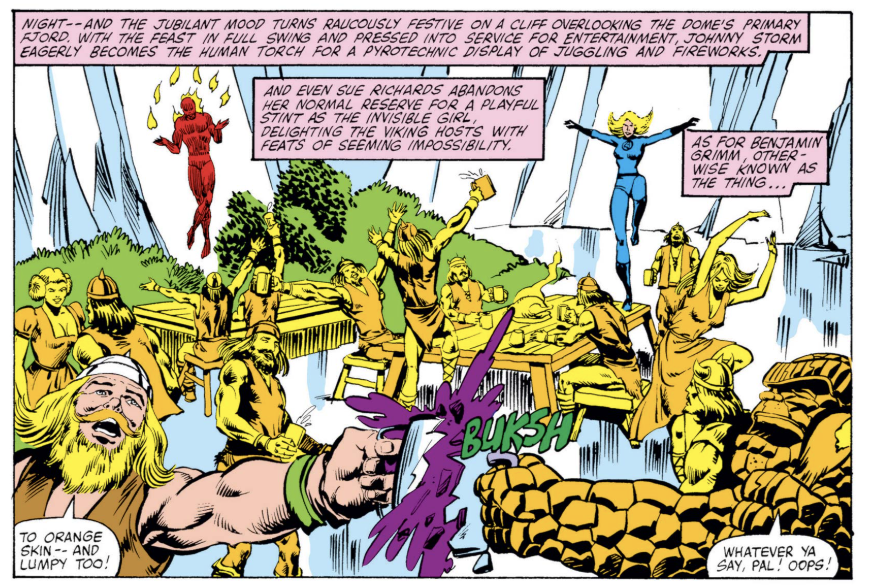


Also, a great house ad by Steve Ditko (this would be an amazing piece of original art to own).


Overall

Good riddance